Gainesville, Texas is located on Interstate 35, 7 miles south of the Oklahoma
border and the crossroad of Hwy 82 and I-35. Our location has been an important
part of our heritage. It begins in 1850 when Gainesville was designated
the county seat of Cooke County and Gainesville stood as an important way
station for the many caravans of Conestoga wagons bound westward along the
southern California Trail. The town received a boost when the Butterfield
Overland Company initiated a new southern stage route that passed through
Gainesville. Economic recovery in the decade following the Civil War depended
upon cattle and Gainesville was strategically situated between two major
cattle routes: the Chisholm Trail to the West and the Sedalia Trail to the
East. The town was the last stop before crossing the Red River into Indian
Territory. During this time Gainesville became an important hub of commerce
and one of the most significant cattle towns in the entire state. By the
early 1880's the local banks held millions of dollars deposited by cattle
barons from all over North Texas. With the cowboys also came a sordid side
of saloons and brothels.
In the late 1870's two factors drastically altered the landscape of Gainesville.
The first spool of barbed wire sold in Texas was sold in Gainesville. Barbed
wire led to the end of the great northern trail drives. Thankfully close
behind was the arrival of the railroad, thus signaling the end of one phase
of history and the beginning of another. By 1890 Gainesville was connected
by rail from Galveston to Chicago and it emerged as one of the most important
cattle shipping towns in all of North Texas.
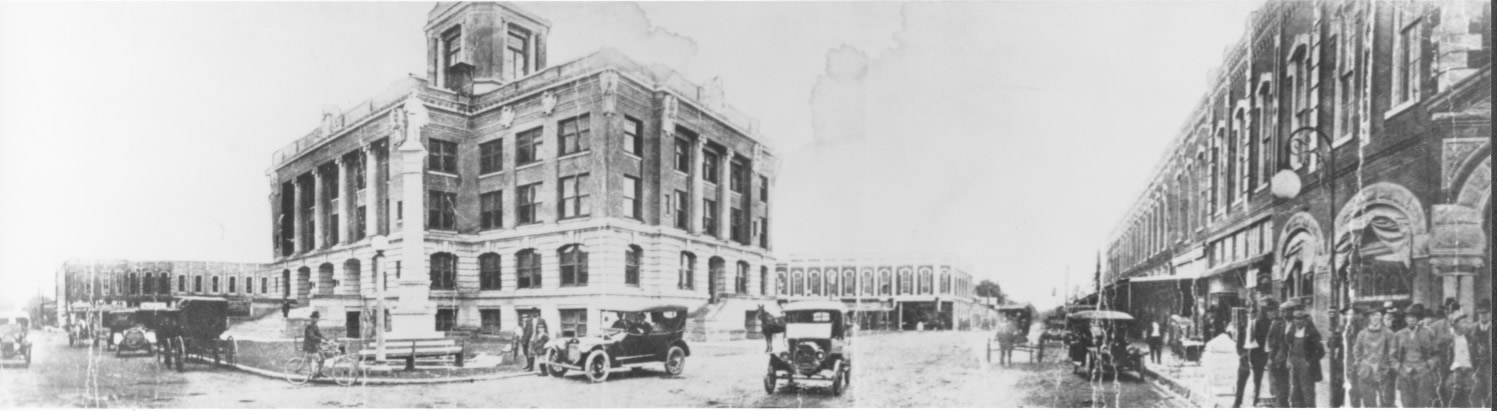
It was during this period that a building boom occurred. Today Gainesville
still boasts a large neighborhood of Victorian homes from this era whose
inventory of brick Victorian homes is second only to Galveston. The historic
commercial district has slowly and lovingly been restored with several buildings
whose upstairs space is still in its original state. More than 240 buildings
have been designated as historic within the city limits.
Ever resilient Gainesville went from 40 saloons to zero when the local
citizens opted not to allow alcohol, this prior to prohibition. The population
began to decline. That all changed on November 9th, 1924 when the Big Indian
Oil Derrick in Callisburg spewed forth a blast of oil that shot over 100
feet into the air. By 1949 over 1700 producing wells had yielded more than
51,000,000 barrels of oil.
The Great Depression left its mark in Gainesville when a local theater
group that was in financial distress decided to hold a circus to raise funds.
What developed was the Gainesville Community Circus. Comprised of Gainesville
residents who volunteered, by 1936 the Community Circus was hailed as one
of the greatest in the nation and featured in the Saturday Evening Post
and Reader's Digest. At its peak, more than 50,000 spectators packed into
Fort Worth's Will Rogers Coliseum to witness the famous traveling troupe
in 1937. Throughout the show world Gainesville was known as the town of
a thousand trapezes. Performances continued until 1958 when the introduction
of television caused decline in spectator attendance.
While many cities were struggling during World War II, Gainesville residents
were fortunate to be the site of an army infantry-training center. Construction
of Camp Howze began in 1942 effectively doubling the population. There were
25 movie theaters open all day and it is said that there were lines of couples
around the courthouse waiting to be married. This was a short-lived boost,
as by 1946 Gainesville was transitioning back to a peacetime economy and
the army disbanded and dismantled the camp.
The event historians know best is the Great Hanging during the Civil War.
This is still a sensitive subject within the community. Cooke County was
one of only 22 counties that voted against succession when the state overwhelming
voted to separate. What remained was a divided community. Passive resistance
to Confederate government developed into open defiance after the Confederate
Conscription Act was enacted. A secret fraternal order known as the Union
League evolved in support of the return of Union government in North Texas.
Hysterical fear of a secret plot by the league combined with the possibility
that the threat had been exaggerated in order to purge the county of all
Union sympathizers led to forty-two men executed. In the end a number of
innocent men died along with the guilty. This tragic chapter in Gainesville
history was symptomatic of an entire nation torn apart by civil war, of
a time when death was common and people were temporarily governed by fear
and hatred.
This rich tapestry of history is preserved in Gainesville through the efforts
of its citizens. With dedication to the preservation of historic buildings
and the private and public commitment of funds to do so, Gainesville builds
upon this foundation by chronicling the personal stories and legacies that
bring our history to life.
City of Gainesville, Texas
http://www.gainesville.tx.us