Mr. Charles William Post
C. W. Post
Founder of Post, Texas (1907)
The Marriage
Cultivators Patents
Illinois Agricultural fatigue
patented bicycle,
business failure travel Texas.
( Post, TX. vision) Fort Worth
Post and Company
Dr. John Harvey Kellogg Advertising diets, fads
Postum "grandfather of advertising"
Post Toasties Grape-Nuts
Pure Food Bill employee relationship
Square Deal
West Texas Garza County, Double U Ranch
This page is sponsored by Maxine Durrett Earl Charitable Foundation Inc.
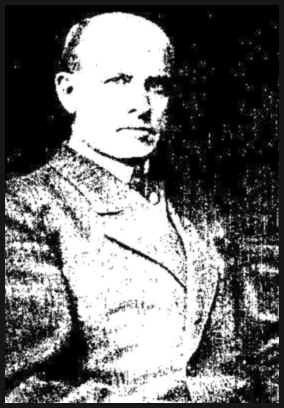 Charles William (C.W.)
Post, was born October 26, 1854 in Springfield, Illinois to Rollin and Caroline
Post. From his very roots there was instilled within Charles the perceptiveness
of an inventor, an adventurer and an industrialist. He was destined to become
one of the country’s most renowned entrepreneurs and philanthropists. But like
so many others during the Gilded Age of fast and furious expansion, his greatest
achievements would not be truly appreciated until after his death that came in
1914.
Charles William (C.W.)
Post, was born October 26, 1854 in Springfield, Illinois to Rollin and Caroline
Post. From his very roots there was instilled within Charles the perceptiveness
of an inventor, an adventurer and an industrialist. He was destined to become
one of the country’s most renowned entrepreneurs and philanthropists. But like
so many others during the Gilded Age of fast and furious expansion, his greatest
achievements would not be truly appreciated until after his death that came in
1914.
Charles went to the Illinois
Industrial University in Urbana, later to become the University of Illinois. He
was thirteen years old at the time. He was anxious to make his mark and his
fortune and
school was a waste of time to him.
After his success in persuading his parents to
allow him to leave school, he joined the Illinois Governor’s Guard. His term in
the guard awakened in Charles the desire to travel. After he left the guard he
met up with and formed a partnership with an old school pal, Charles Moody. They
decided to explore the wild West. They headed for Oklahoma Territory and the
plains of Kansas. Even in those days the life of being a cowboy held a certain
fascination for a young boy. They traveled extensively across the Southwest in
search of business prospects and their fortune.
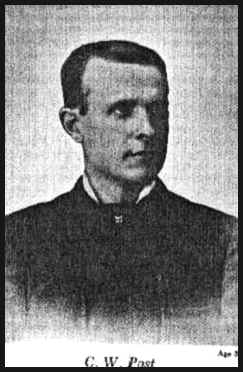 On November 4, 1874, Charles William Post was to marry Ella
Merriweather, his childhood
On November 4, 1874, Charles William Post was to marry Ella
Merriweather, his childhood 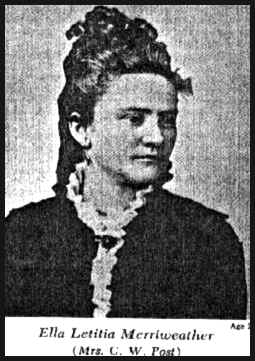 sweetheart. They were married
at Pawnee, Illinois. She was twenty-one years of age, and he was twenty. The
took
place in the home of her Uncle. She was a music lover and a dancer. Both were industrious
and ambitious, the perfect couple for what lay ahead in their future.
sweetheart. They were married
at Pawnee, Illinois. She was twenty-one years of age, and he was twenty. The
took
place in the home of her Uncle. She was a music lover and a dancer. Both were industrious
and ambitious, the perfect couple for what lay ahead in their future.
The marriage seemed
to add fuel to Post’s already tremendous energy, though his bride was rarely seen
with him in public. She preferred to remain in the Post family’s rambling Victorian
estate. Though unnoticed at the time, the once lovely bride was to slowly slip into
depression and become a virtual recluse from society. This seclusion would later lead to
an end of what Charles felt was the perfect marriage. With her beloved Charles constantly
gone she gradually, became disconcerted in the relationship.
Beginning to show signs of health breakdowns and fatigue, Charles
made the first of his major business decisions. He came to the realization that big
profits in the farm implement business came from manufacturing, not selling. In 1880, the
ambitious inventor was to give up traveling and the road for more prosperous ventures.
With a business at home, Ella felt she and Charles could spend more time together. But it
was not to be.
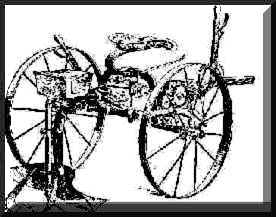 Charles decided to start manufacturing agricultural
machines and to begin making improvements on the ones already in existence. He had a
tremendous foresight and an ability to anticipate the future. With the help of a friend,
A.L. Ide, he put to use his ideas and applied for a patent on an improved planter they
manufactured October 11, 1878. The patent was granted.
Charles decided to start manufacturing agricultural
machines and to begin making improvements on the ones already in existence. He had a
tremendous foresight and an ability to anticipate the future. With the help of a friend,
A.L. Ide, he put to use his ideas and applied for a patent on an improved planter they
manufactured October 11, 1878. The patent was granted.
He formed a manufacturing company. Capital for the expansion proved
no problem for the diligent inventor. Many investor were family members and business
people of the community who believed in his ideas and had faith in his now proven business
abilities. "Post Capitol City Cultivators" was opened in his wife’s name,
as her funds were used as security with which to establish the loan.
Sulky Plow
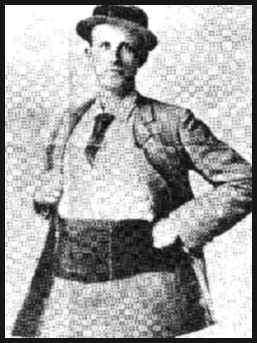 It was not long before the company was well known in the farm manufacturing industry and
expansion was called for. The company was booming and the work load was increasing along
with it. Between the years of 1879 and 1897, Post applied for and received patents
on the
following inventions:
It was not long before the company was well known in the farm manufacturing industry and
expansion was called for. The company was booming and the work load was increasing along
with it. Between the years of 1879 and 1897, Post applied for and received patents
on the
following inventions:
Seed
Planter, March 4, 1879
Steam Pump, September 9, 1879
Cultivator, April 4, 1882
Sulky Plow, November 28, 1882
Cultivator, June 28, 1883
Harrow, May 24, 1883
Hay stacker, March 25, 1890
Suspenders,
November 7, 1893 and
Cooking Utensils, January 5, 1897
The Patent
numbers can be found by contacting the U.S. Patent Office. Through these inventions he was
to realize considerable revenue and prestige.
Other Post inventions, though not
patented, included a new version of player piano, a paddle to be
used to generate electricity from water power and a revised bicycle.
Supply was simply unable to meet the demand. More room and faster tooling was
needed to meet the requirement. On November 10, 1885, Post entered into yet a larger
factory. This one organized by a corporation called the Illinois Agricultural
Works.
Charles’ relentless creativity required his constant absence from home. It was not
long before Ella became even more saddened in her marriage to Post. She lapsed even
further away from the public and remained in their home, increasingly more detached. It
seemed to her that even friends and acquaintances looked down upon her.
Soon his business became so
successful that a local banker tried to take control of the company by means of a note.
The note was to be signed by Post’s mother and father without the knowledge of their
son. The parents had been induced to sign a mortgage on their homestead as additional
security for the note on the business. Some believe this was the onset of the many nervous
breakdowns he was to experience in his life. The quarrel between the banker and Post went
on for many years, well into his Battle Creek years.
Charles felt the need to be
involved in every aspect of each venture he was associated with. Soon overwork, constant
strain and fatigue began to take its toll on his health. He found a temporary cure in the
time he spent relaxing with Ella. He felt rest was all that was needed. Ella found
sanctuary in what he felt was a temporary setback. They were finally able to spend a small
amount of time together.
They worked on music rolls for his
improved player piano. They sat for hours and cut the tiny holes needed in the rolls.
During this same time he was to add two wheels of the same size to the already patented
bicycle, which previously had a wheel of different sizes on opposing ends which added to
the instability and was the cause of many injuries.
Slowly, and against the advice of his
wife and doctors, he began adding work and returning to his usual rigorous schedule. It
was only a short time before the results of the load caught up with him. Post suffered
what was to be the beginning of many serious nervous breakdowns and ill health in 1885. He
was forced to remain home and was not allowed access to any business dealings. Soon the
company felt his absence and liquidation of the firm was taken by the bank. This forced
him to relinquish his position with the company. This was the only major business
failure he was to
experience in his career.
It was many years before he was
able to set the record straight on the matter of what really transpired in the
business’s down fall. His complete recovery from this severe breakdown and collapse
was extremely slow and required several months. Again, he devoted his time to inventions
and relaxation.
His
doctors informed him that as soon as he felt he was capable of travel, he should consider
a move to a warmer and drier climate. Post chose to travel
Texas. He roamed the range of the Llano
Cattle Company’s Curry Comb Ranch in the High Plains as a cowboy under the name of
Charles Williams. The solitude of the undeveloped West offered the freedom and the healing
touch that he felt he needed. He slowly improved and expanded his range to other regions
of West Texas. It is then, the reputed story goes, that he sat under a Mesquite Tree on
the Caprock and looked down on the panoramic view and envisioned a beautiful City, an
oasis in the desert. He saw streets lined with trees, wells brimming with cool water,
grazing herds of cattle and a flowing sea of cotton bending in the breeze. This dream of a
new world in the wilds would not be forgotten in his mind, it would remain forever …
and eventually come true. ( Post, TX. vision)
C.W., along with his brother
Carroll, struck out for the wild and adventurous country of Fort Worth, Texas in search of
a future. A suitable location and business investment was found and the two returned to
Illinois with the news and well thought out plans for the future of the entire Post
family. A place to live and a means of support for the family had been found.
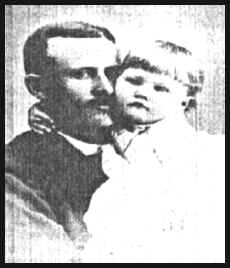 With the help of a group of real-estate investors, they purchase a 200 acre ranch
on the outskirts of Fort Worth. Fort Worth was a booming cow town and Post saw the
investment as a prosperous venture that offered little, or no mental or physical effort,
but offered a tremendous return. In 1887 the entire family moved to Fort Worth, with the
exception of Ella and C.W. They remained behind waiting for the expected birth of their
first and only child in the fall. The rest of the family went to Texas and began Post and
Company, a real estate business. Following the birth of their child, C.W. and Ella first
went to California, to further his recovery.
With the help of a group of real-estate investors, they purchase a 200 acre ranch
on the outskirts of Fort Worth. Fort Worth was a booming cow town and Post saw the
investment as a prosperous venture that offered little, or no mental or physical effort,
but offered a tremendous return. In 1887 the entire family moved to Fort Worth, with the
exception of Ella and C.W. They remained behind waiting for the expected birth of their
first and only child in the fall. The rest of the family went to Texas and began Post and
Company, a real estate business. Following the birth of their child, C.W. and Ella first
went to California, to further his recovery.
In February
of 1888 they joined the rest of the family in Texas. There they first resided in the
famous and then new, Ellis Hotel, considered the best in town. It is quite possible it was
there that he acquired his love for the white Stetson hat and Texas attire that was to be
associated with him the rest of his life. He settled in the Post and Company offices and
soon became a trustee of that company as well as secretary of the East Fort Worth Town
Company. Post moved in May of 1888, from the Ellis Hotel to their ranch.
With his renewed health, he once
again regained the confidence that was necessary in business. He persuaded businesses of
many types to relocate to their land. He knew the importance of the location, close to the
city and near a railroad and he stressed these advantages during his long and arduous
business meetings for the next two years. He in fact laid out the town. This was also to
be of advantage to him in later years when he was to build his own city in the wilderness,
Post City. It seemed as though he had found his elusive gold mine. This was
where he was to make the fortune he knew he was destined to make. But once again, doom was
lurking in the background to spell disaster in his life.
In the fall of 1888 He suffered
another nervous breakdown, this one more severe than the last. He was forced to abandon
his work. His illness was labeled as chronic by the Texas doctors, but his family
would not accept this diagnosis. They believed rest would once again be the cure. As
before, they joined together and sacrificed by sending him away where he would be free
from the daily pressures of work. Leaving the company to devote his entire time to
recovery, he spent the summer of 1889 on the Atlantic seaboard. During the winter of that
same year, he returned to Fort Worth. With his health improved and with new enthusiasm he
turned his interests back to more adventurous businesses. This time his project was
building a woolen mill, four miles southwest of Fort Worth. Knowing the significance of
getting your manufactured product to market, he chose a location on the Houston &
Texas Central Railway.
In the
fall of 1890 he approached another ambitious project, another mill. This time the project
was more inventive than before. Knowing that the West was fast filling with people who
would need homes and these homes, out of necessity, would be built primarily of wood, he
felt trees would soon become scarce. Post intended making paper from the over abundance of
Texas cotton seed hulls. But his ambitiousness and over work once again took its toll on
his health. This time it was even more serious. He became an invalid and rest would not be
the answer this time. He needed expert medical attention immediately. The family had heard
of a nationally known clinic in Battle Creek, Michigan, then no more than a wide spot in
the road. It’s tactics were considered unorthodox for the times, but its reputation
for success was widely known and could not be dismissed. Dr. John Harvey Kellogg was their
answer to what had been declared a hopeless cause.
Post,
his wife and his daughter boarded a train for Battle Creek, Michigan. They arrived there
in February of 1893. His deteriorating health had him Confined to a stretcher. He was only
a shadow of the towering figure he was to become.
Battle Creek had become a gathering
place for illnesses that common medicine had failed to cure. C.W.’s arrival in Battle
Creek was to effect the future of generations of people around the world. It would not
only affect breakfast foods, cereals, health and politics, but it revolutionized and
perfected an industry that had not yet been envisioned; fast food and mass advertising.
Oat meal used to be cooked for long hours in a hot kitchen on a wood stove, sometimes
taking all night to prepare. Advertising was done only on a limited local basis and
national advertising campaigns were thought useless. Is it possible that places like
McDonalds, Burger King, Pizza Hut and others inadvertently owe their allegiance to C.W.
Post, and his advertising expertise?
The sanitarium had gained nation
wide acclaim. Its approach to healing was through proper foods, meatless meals, mental
science, calisthenics, water therapy and many fads of the time. The approach was
controversial for its time, though it seemed effective, and the sanitarium reputation was
unprecedented.
Due to the great success at the
sanitarium of people like Dr. John Harvey Kellogg, may physicians, and advocated of
various types of diets, fads and cure-alls flowed into Battle Creek by the trainload.
Dr. Kellogg and his brother had not
yet successfully marketed a health food. But C.W. Post, the man who arrived on a
stretcher, was the one to show them the way.
Having found a new way of eating
and with his health recharged, Post remembered a concoction he had been served on the
Texas Plains. Farmers wives, with little or no store bought goods had come up with a
mixture of their own as a substitute for coffee.
The mixture was a blend of chicory,
with roasted wheat and other grains found in the Texas Plains. Post began experimenting
with the mixture after his health had been restored. Coffee’s side effects on the
body were of concern to Post, but he liked the taste. He put all his efforts into making a
substitute with the same taste, but without the ill effects that caffeine had on the body.
He
established the La Vita Inn, a sanitarium at Battle Creek, and systematically began work
on his coffee substitute. After a year of relentless work and experimentation, a suitable
substitute was developed from wheat, bran and molasses, which he thought was tastier than
chicory. He gave his mixture the name, Postum Food Coffee. At
this time, 1894, not many food stuffs were advertised. Most advertising went to soaps,
stove polish, patent medicine and the like.
After perfecting his Postum
Food Coffee, Post was left with the problem of marketing his product. Getting the
product into the public eye was the key to a successful product, as much or even more than
its quality.
He knew that no matter how good a
product was, if the buying public was not aware of it, they would never taste it. In
February, 1895, Post went to the neighboring town of Grand Rapids, Michigan. With a larger
population, larger grocery stores and a newspaper with a wide circulation, the Evening
Press, he launched a massive advertising campaign.
His first move was expansion to a wider
market. By advertising in a wider area, a wider market demand was created. After repeated
expansion and advertising, Post had created the FIRST nation wide advertising campaign in
this country. While C.W. Post has been called the "grandfather of advertising",
he did not originate advertising though he did become the largest single advertiser in the
country. He led the way for more diversified and flamboyant ad copy by what he preferred
to call "plain words for plain people".
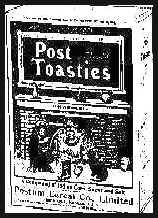
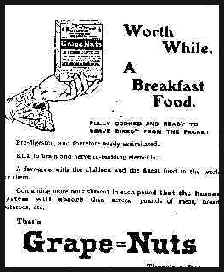 In the first year
of business sales were a mere $5000. By 1896, however, sales had topped the $260,000 mark.
1897 brought sales of over $840,000 and a new product with which Post’s was to become
synonymous, Grape Nuts, and shortly after came Post Toasties.
In the first year
of business sales were a mere $5000. By 1896, however, sales had topped the $260,000 mark.
1897 brought sales of over $840,000 and a new product with which Post’s was to become
synonymous, Grape Nuts, and shortly after came Post Toasties.
Post’s genius in advertising
promoted a good breakfast food that could be prepared quickly and was packaged with health
in mind. Other businessmen seeing the value of Post’s advertising campaigns,
attempted to cash in on his success.
Soon Charles was to feel the
pressure of the competition. Sales began to fall. A wide spread advertising campaign was
launched targeting imitation products. Friends urged Post to make a cheaper grade of Postum,
but he refused. With his usual cunning and courage, Charles took a great risk. He
organized a separate company named Monk’s Brew and sold the product at
one-fifth the price of Postum, five cents a package. The packages proclaimed they
contained a product that was equal to the quality of Postum. This was a true
statement. The boxes were indeed filled with genuine Postum, under the name of Monk’s
Brew.
Post’s cooking process was
also innovative and he sought to protect it from competitors who might attempt to
duplicate it. He applied for a patent on his Cooking Utensil. It was granted to him in
January, 1897. Grape-Nuts was introduced to the market for the first time in
January of 1898, and to this day it is Post’s only product not successfully copied by
a competitor.
By 1909 Grape-Nuts and Post
Toasties had surpassed Postum’s annual profits of $1,460,009. Post
attributed this to his advertising campaigns. Simplicity is what he used in his campaigns.
He believed that intimacy was important to the women of the world. If they could relate to
you as a friend, they would trust you and your product. This would influence their buying
habits.
Charles bought large ads in newspapers nation wide. He spoke
concerning health matters, and launched a Pure Food crusade. Through this he was
directly responsible for getting the Pure Food Bill passed. Post had by this time
successfully marketed his products in South America and England. W.K. Kellogg, a cereal
competitor, had launched his breakfast food, but was not able to beat Post’s world
wide reputation. It was not until after Post’s death that Kellogg’s sales made
any substantial climb.
Most of Post’s
advertising campaigns had been written by him personally. Post felt that fancy wording was
intimidating to the average housewife. Simplicity, sincerity and plain truth were a
language that people could relate to, and that was the key. By the twentieth century, Post
had gained world acclaim as an authority on advertising.
Post's’s products had brought him great wealth. But once again it began to
take a toll on his already frail health. He traveled extensively as a form of relaxation
to countries of continental Europe. He went to England on a yearly basis. This allowed him
the luxury of relaxation, but also a chance to keep in constant touch with his English
branch.
His great wealth did not
make him lose touch with reality. He felt a kinship with his employees. he tried
desperately to maintain a paternal kindness toward them. It was not until his corporations
has grown so immense he knew only a small portion of his employees, that his personal
employee relationship with them ended, and for this he grieved.
Even though Charles was
unable to be personally acquainted with his employees, he did no neglect them, nor did he
ignore what he felt his duty to return to mankind a portion of what it had given him.
He believed that first impressions
were lasting impressions. Against advice from his friends and associates, Post erected an
elaborate hotel, Post Tavern. He remembered what it meant to be able to enter a strange
town and find a comfortable bed, good food and a friendly atmosphere.
Charles’
concern for his employees did not stop with material things. He felt a true concern for
their labor-management struggle as well. He paid well, and saw that his employees had as
safe a working environment as possible. His fight with the American Federation of Labor
soon became well known. Though his employees knew of his generosity, the rest of the world
saw him as a merciless businessman. But Charles was not as he appeared to the masses, and
soon the nation was to realize this.
Soon Mr. Post was elected
president of the National Industrial association, an organization founded in 1903 that was
against closed shop. He renamed it the Square Deal, with, "The National Organ of the
Open Shop Movement," as a spearhead. Post was revered by capital as a gallant
champion and by labor as its worst enemy.
In
the fall of 1906, Charles employed a Texas rancher, T.P. Stevens, to look over some
ranches for him in West Texas. Post bought 213,324 acres of land, including 333 square
miles of Garza County, on which he was to build his town.
As C.W. Post became more
active in political and labor activities, and with his daughter going to private school in
Washington, he set up a Cabinet of management to handle his affairs in Battle Creek, as
well as his affairs in Texas.
His Texas affairs manager was
H.C. Hawk. Hawk was responsible for stocks, bonds, real estate and supervision of the
Double U Ranch beginning in 1906. His other control included, Canadian Postum Cereal Ltd.,
Grape Nuts, Enquire Publishing Company, Home & Fireside Magazine, Young Fuel &
Pure Ice Company and a labor publication known as Square Deal.
It seemed as though anything
he touched turned a profit. All but one, that is, Elijah’s Manna. It was introduced
in 1906, as a prepared breakfast food. The name in itself was to cause him much grief and
anguish. The American religions accused Post of sacrilege. Though he protested, he was
forced to recall the product and repackage it under the name of Post Toasties. Post
Toasties made him a net profit of $2,185,820 in 1908.
The Story Continues in Post, Texas