FIRST RANCHES
"GARZA COUNTY, WE SALUTE YOU..."
Way back when time was young, the
seas dried up around you.
The rugged caprock rumbled down gouging canyons to feed the old Brazos River...Red arroyos
thicketed with wild plum and sweet algeritas, cut through miles and miles of lush mesquite
grass. The Indian and buffalo came and went before you ever had a name. Man
moved in. He gave you a name -- "Garza". You nurtured the cowboy and his
herds, the farmer and the mill, and a thousand wells belching oil for a motorized world.
Under your sod lie some of our beloved pioneers. Cherished memories linger
with the ever-increasing splendor of your towns, homes, and ranches. Garza County,
we salute your wholesome progressive citizenry.
-- Ross Edwards --
Indeed, thousands of years before Garza became a county, this part of what is now Texas
was a vast and trackless sea. It was only after the sea dried up and the plains
oozed with springs that became lakes that man made his first appearance.
The first recorded history came much later in the form of
Indian pictographs, which are found from the Rio Grande to the Texas Panhandle, including
some on the U Lazy S Ranch on the southern part of Garza County.
The roots
of the late John Bunyan Slaughter, philanthropist and original owner of Garza County's U Lazy S Ranch, extend back
as far as the Republic of Texas and the Mexican War.
His father, George Webb Slaughter, fought in that war and
as a courier under General Sam Houston, carried one of the messages advising the
evacuation of the Alamo.
After his marriage, on October 12, 1836, to Miss Sallie
Mason, George W. Slaughter continued to organize men and fight the Indians when it became
necessary. One of these battles was with the Cherokee Indians. Captain
Slaughter led a group that fought the Cherokee under the leadership of Chief Bowles.
The Chief and several hundred of his warriors were killed. The Cherokee gave
up the fight.
In 1857 Mr. Slaughter moved his family and stock into Palo
Pinto County, where he settled for the rest of his life. Here, on Sundays, the first
of the cattle Slaughters was "Parson" Slaughter, a tall bearded man with a
booming voice. He "preached the Word" in the frontier churches of the area
at a time when he had to keep his six shooters holstered on him, and his rifle leaned
against his pulpit. The congregation was also fully armed because the Comanche
Indians had no respect for church worship and might show up right in the middle of the
sermon.
Born in Sabine County, Texas, December 15, 1848, John
Bunyan Slaughter was nine when he moved with his family to this new Texas Frontier.
In May of 1865, John, at the young
age of 17, went on his first cattle drive. During this drive they were attacked by
Comanche Indians and the trail boss and another young man were killed and scalped.
John took charge of the drive, after the deaths, on the insistence of the other cowboys.
In the Spring of 1871, the Slaughters and their cowboys
were preparing for the season's round up. John went to the corral for the horses,
and an Indian seemed to come out of the ground and shot him in the right breast, it came
out his back. John was back in the saddle in six weeks. In succeeding years he was
wounded five more times by Indians but none as serious as the
first.
In July, 1880, John married Miss Isabella Masten May of
Dallas, Texas, and took her by wagon, with all of the furnishings, to the house he had
built on Scalawag Creek, near Crosbyton, which she later renamed Home Creek. The
freight on the lumber for the house, hauled 350 miles from Fort Worth, came to more than
the cost of the lumber.
Their first daughter, Mamie, was born November 16, 1882 in
Dallas. During the next 15 years, a son, John B. Slaughter, Jr. was born July 15,
1891, and another daughter, Louie Antoinette Slaughter was born July 21, 1894, in Colorado
City, Texas.
In 1901, John B. Slaughter, Sr.
bought from the Nave McCord Cattle Company, at $1.60 an acre, the Square and Compass Ranch
comprising 150,000 acres. In 1906 he sold to C.W. Post, 50,000 acres from the west
side of the ranch which Mr. Post add to the Llano Ranch that he had already
acquired. Mr. Slaughter later refused to sell the entire ranch to Mr. Post.
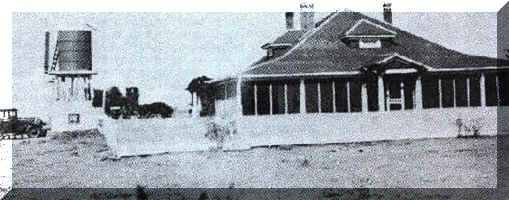
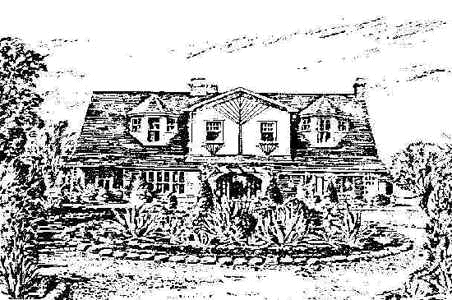
After seven years, Mr. Slaughter built a home on the
U Lazy S Ranch with
lumber freighted by wagon from Colorado City. This house, until it burned in 1936,
was one of the well known landmarks of West Texas.
 Mr. Slaughter was interested in crossing the buffalo with the beef cow. The first
cross, the Cattalo, was fairly common but he achieved the impossible second cross, the
Vernier, though it had no economic value. The ranch became a State Game Preserve in
1925 and he took great delight in making pets of the five head of deer that were shipped
to him from South Texas. From this seed stock have come the deer that now populate
this region.
Mr. Slaughter was interested in crossing the buffalo with the beef cow. The first
cross, the Cattalo, was fairly common but he achieved the impossible second cross, the
Vernier, though it had no economic value. The ranch became a State Game Preserve in
1925 and he took great delight in making pets of the five head of deer that were shipped
to him from South Texas. From this seed stock have come the deer that now populate
this region.
John B. Slaughter continued to be very active in his
ranching interests until his death November 11, 1928, a few weeks short of his 80th
birthday. But the U Lazy S continued, and remains a profitable business enterprise today, under the
direction of Slaughter's great grandson, Jack Lott.
Our county and many of our lives have been enriched because
John B. Slaughter and his descendants have shared with us.
During
the days of the open range in Texas in the early 1880's, the first cattle
ranch of which there is a record available here, operated in the southeastern portion of
Garza County. It was known as the Lexington Cattle Company of Lexington,
Kentucky. Mr. German B. Stoud, a fine man, had about 500 head of cattle on the
Yellow House Creek in Garza County, just east of the Llano (Curry Comb) Ranch. His
brand was '202'. Mr. Long also had cattle in the area in 1881.
In January of 1884 Mr. Long began buying land and more
cattle. Some of the cattle Mr. Long purchased came from the Overall and Street Ranch
south of Fluvanna. These cattle, with the 'EO' brand, were consolidated with the
'202' herd from the Lexington Cattle Company and given a new brand, the 'OS'. Mr.
Long and his brother operated the ranch, bought additional land, built fences -- which
before this time had been built only across gaps in the mountains to prevent drifting.
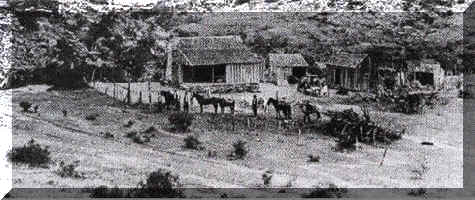 OS Ranch Headquarters, 1898----------------------
In June of 1901, the Longs sold all
their holdings, consisting of 26,411 acres of school land, various grass leases, fences,
etc., to W.E. Connell, John Scarborough and E.W. Clark, for approximately $40,000.
They also sold their herd of 9,500 stock cattle, 312 bulls, and 118 horses, together with
all wagons, harnesses, scrapers, cooking and camping equipment, to Connell and his
associates for $200,239.25. The new owners added improvements and continued their
purchases of both school and railroad land until their range embraced 100,000 acres.
In 1909, Connell bought John Scarborough's one-fourth
interest of 55,371.3 acres of land and in 1913 he bought E.W. Clark's one-fourth interest
of 57,169.13 acres. Now he was sole owner of all the OS Ranch except for 27,175
acres the partners sold to C.W. Post in 1906.
The OS
Ranch has been important in the history of Garza
County. It was here that the election was held to organize the county, back in 1907.
It was also on the OS Ranch that some of the first oil wells in Texas were brought in.
At this time the OS
Ranch is still owned and operated by children and
grandchildren of W.E. Connell.