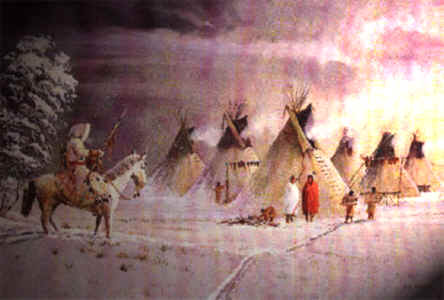

Taba'na Yuan'e Garza Arrow Points: Apache, Comanche,
Kiowa Indians
Native Americans in Garza County
Taba'na Yuan'e Garza Arrow Points:
Apache,
Comanche,
Kiowa Indians
Page Sponsored by:
WELLS FARGO BANK
of Post, Texas
 |
TABA'NA YUAN'E |
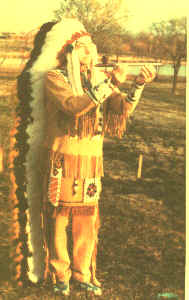
Taba'na Yuan'e means "Sunrise
Wind". An authentic dance
used by Plains Indians in which the wind's direction at the exact moment of
sunrise to determine the success of the coming year.
According to legend, the wind must be checked at sunrise on the day after the
sun reaches the halfway point in its journey from south to north.
A east or northeast wind means: a "very good year". A north or
northwest wind indicates an "average year". A west or southwest
wind predicts a "poor year" and a south or southeast wind is
"very bad year."
The predictions are determined by the direction of the smoke rising from a fire
built in the center of the ceremonial circle. The "Chief" and
his dancers perform a Four Winds Dance, with the singing of the tribal prayer
honoring Mother Earth and to Wakantanka, the Great Spirit Above, seeking their
blessings.
Garza Arrow
Points:
The Garza point is a triangular light arrow point with a single basal notch. The
edges of the blade are straight and sometimes serrated. The Garza shows beautiful
flaking, but sometimes may only be chipped on one side.
Collectors have been finding Garza types for many years in West Texas. However, no
name was known for these finely chipped arrow points until 1959 when the South Plains
Archeological Society excavated a small site in Garza County, Texas. The Garza point
got its name from thirteen triangular points, which had a centrally placed basal
notch. They were excavated from a site about 16 miles south of Post, Texas.
The actual naming of the Neo-American point is credited to Frank Runkles and Emmett Shedd
who supervised the field work on this excavation.
The evidence from this site indicates that the Garza and triple-notched Harrell points are
associated and found at the same levels, but it is very rare to find a Garza and a
two-notch Harrell point from the same occupational stratum. It is believed the date
for the Garza point is from 1000 to 1500 A.D.
A few collectors in this immediate area have found Garza points, but they must be
considered very rare and unusual artifacts. These single-notched basal points have
been found occasionally from El Paso to Clovis, New Mexico and back to Post, Texas.
However, Garza County and the counties which are adjacent to it, produce the greatest
abundance of these single-notched basal points.
 |
 Texas early
exploration and missionary efforts dated from 1519 to 1690 and through
1793 was the mission settlements and Spanish dominion.
Texas early
exploration and missionary efforts dated from 1519 to 1690 and through
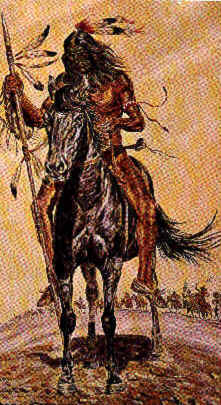
1793 was the mission settlements and Spanish dominion. The Lipan Apache Indians held sway during the early mission period, before the mid-1700s the Lipans were driven South & Westward by the fierce Comanche, who at first occupied just the upper Panhandle of Texas. From then on, the Indians knew that (now) Garza County was "Comanche Country". It remained that way until Quanah Parker took the straggling remnants of his tribe to surrender at Fort Sill, Oklahoma Territory. For a century and three quarters the Comanche harassed the Spaniards, their Pueblo neighbors in New Mexico, and terrorized the Texas frontier with numerous raids. |
|
During the war Between the
States and immediately following, the Comanches, now joined by their fierce kinsmen, the
Kiowa, took captive many white women and children, killed large numbers of frontier people
and drove the settlers back into Northern Texas. Treaty followed treaty, between these Indians and the government, but there were constant uprisings by the Indians to break the truces until finally the US Army began a merciless campaign against all Indians found off their reservations. This campaign did not close until the resistance of the Comanche and allied tribes was broken in 1875. The first white settlers came in the early 1870s when buffalo hunters were gradually replaced by cattlemen. The buffalo was one attraction that had made the region popular with the Indian. Their way of life was determined by abundance of horses and buffalo on the grass- covered plains. They subsided largely on vast herds of buffalo for meat, warm and heavy clothing, and covering for lodges. |
APACHES
INDIANS:
The name Apache
most
 probably
came from the Zuni word apachu, meaning
"enemy". The Apaches referred to themselves as
Inde or Dine', meaning "the
people" Generally, the Apaches
are divided into Eastern and Western, with the Rio Grande serving as a dividing
line. Two groups, the Lipans and the Mescaleros,
lived partially or entirely within the confines of Texas. The Apaches
went by numerous names. But only the names of Lipans and Mescaleros
survived into the nineteenth century.
probably
came from the Zuni word apachu, meaning
"enemy". The Apaches referred to themselves as
Inde or Dine', meaning "the
people" Generally, the Apaches
are divided into Eastern and Western, with the Rio Grande serving as a dividing
line. Two groups, the Lipans and the Mescaleros,
lived partially or entirely within the confines of Texas. The Apaches
went by numerous names. But only the names of Lipans and Mescaleros
survived into the nineteenth century.
Apaches arrived
in the Southwest between A.D. 1000 and 1400. They apparently migrated from the North
along the eastern side of the Rocky Mountains, then spreading westward into New Mexico and
Arizona. In time, pressure from the Comanches and other tribes
pushed the Apaches farther south and west.
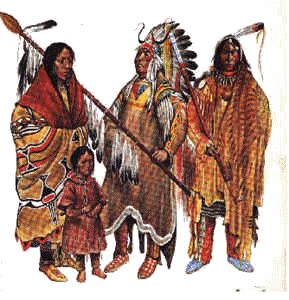
The Apaches were nomadic and
lived almost completely off the buffalo. They dressed in buffalo skins and lived in
tents made of tanned and greased hides, which they loaded onto dogs when they moved with
the herds. They were among the first Indians to learn to ride horses,
learning from the Pueblos. They turned their new equestrian
skills to raiding for horses and supplies. The Spanish first contacted the Apaches
in 1541.
From 1656 to 1675, Spanish settlers and Pueblo
Indians of New Mexico suffered heavily from
almost continuous Apache raids. Their aggressive behavior turned
their neighbors into enemies, and a new, potentially powerful tribe, the Comanche,
began pressuring the Apaches from the North. By 1700 the Apaches
began migrating southwest as the Comanche, Wichita, and Tijas
Indians began to occupy the dominant position on the South Plains. In addition, the Apaches
had never adapted completely to a Plains culture. The attempt to improve their
source of food was a major cause of their defeat by the Comanche.
During the Apache
flight from the
Comanche,, many groups moved westward. The Lipans and the
Mescaleros, fled southward into Central Texas. There they collided with the
Spanish. When the Spanish founded San Antonio in 1718, the Apache
discovered a convenient accessible location at which to stage raids against their European
enemies.
During the 1730s and 40s, the Apaches
and Spaniards continued to wage war on each other. But on Aug. 19, 1749, four Apache
chiefs with numerous followers buried a hatchet along with other instruments of war in a
peace ceremony at San Antonio. The Apaches, decimated by Comanche
raids, appeared willing to accept Christian conversion in exchange for protection by the
Spaniards. The first formal mission for the Texas Apaches was established not at
San Antonio, but in the jurisdiction of San Juan Bautista on the Rio Grande. Less
that a year later, the neophytes became discontented, revolted, burned the mission
buildings and deserted. The missionaries blamed the failure of that first Apache
mission on the natural inconsistency of the tribe, as well as on their reluctance to live
away from their homelands.
The Texans drew up
their own treaty with the Lipan Apaches in 1838. An alliance
that broke down in 1842, more than half the Lipan joined the Mescalero.in
Mexico.
In 1873, Col. Ronald S. Mackenzie led a
force of 400 soldiers into Mexico to destroy the Lipan villages. His army killed or
captured virtually the surviving Lipans. They were deported to the Mescalero
Reservation in the Sacramento Mountains of New Mexico. In 1905 the rest of the
Lipans in Mexico drifted onto the Mescalero Reservation. In 1970, about 1660 Indians
were enrolled there.

COMANCHE INDIANS
The Comanche, exceptional horsemen who dominated the Southern Plains,
played a prominent role in Texas frontier history. Anthropological evidence indicates that
they were originally a mountain tribe, a branch of the Northern Shoshones, who roamed the
Great Basin region of the Western United States as crudely equipped hunters and gathers.
Both cultural and linguistic similarities confirm the Comanche’s Shoshone origins.
Some time during the late 17th century, the Comanche acquired horses, and that
acquisition drastically altered their culture.
The life of the pedestrian tribe was revolutionized as they rapidly evolved into a
mounted, well-equipped, and powerful people. Their new mobility allowed them to leave
their mountain home. After they arrived on the Great Plains, the Comanches began a
Southern migration that was encouraged by a combination of factors.
By moving south, they
had greater access to mustangs. The warm climate and abundant buffalo
were incentives for the Southern migration. Pressure from the Blackfoot and
Crow Indians also encouraged their migration. A vast area of the South Plains, including
much of the North, Central & West Texas, soon became Comanche country or
Comancheria.
Only after their arrival on the Southern Plains
did the tribe come to be known as
Comanches, a name derived from the Ute word Komantcia, meaning
"enemy" or, literally, "Anyone who wants to fight me all the time."
Although the tribe came to be known historically as Comanches, they called themselves Nermernuk,
or "The People".
The Comanche did not arrive on the Southern Plains as a unified body, but in numerous family groups or bands. The band structure of the Comanche society was not rigid, and bands joined together and broke apart, depending on the needs and goals of the members. As many as thirteen different Comanche bands were identified during this historical period, and most likely there were more. Five major bands played important roles in recorded Comanche history.
The southernmost band was called Peneteka, or "Honey Eaters". Their range extended from the Edwards Plateau to the headwaters of the central Texas rivers. Because of their location, the Penetekas played the most prominent role in Texas history.
North of Peneteka country was the habitat of the band called Nokoni, or "Those Who Turn Back". The Nokoni roamed from the Cross Timbers region of North Texas to the mountains of New Mexico.
Still farther North was the range of the Kotsotekas, or the "Buffalo Eaters". Their territory was what is now Western Oklahoma, where they often camped along the Canadian River.
The northernmost band was known as the Yamparikas, or "Yap Eaters", a name derived from that of an edible root. Their range extended north to the Arkansas River.
The fifth major band, known as Quahadis, or "Antelopes", roamed the high plains of the Llano Estacado.
The Comanches remained a nomadic people throughout their free existence. Their
predominantly meat diet was supplemented with wild roots, fruit and nuts, or with produce
obtained by trade with neighboring agricultural tribes.
Because of their trading skills, the Comanche controlled much of the commerce of the Southern Plains. They
bartered buffalo products, horses, and captives for manufactured goods and foodstuffs.
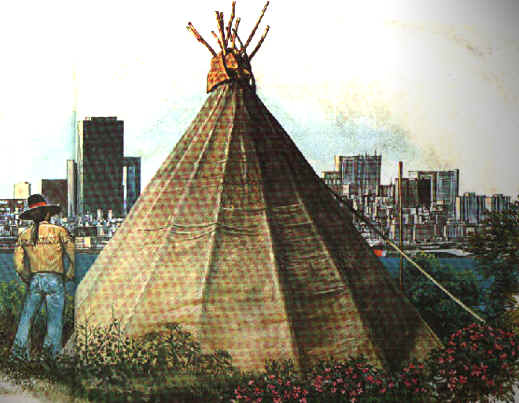
The
familiar plains-type tepees constructed of tanned buffalo hide, stretched over 16 to 18
lodge poles, provided portable shelter for the Comanches. Their clothing made of bison
hide or buckskin, consisted of breech cloth, leggings and moccasins for men, and a fringed
skirt, poncho-style blouse, leggings and moccasins for women, buffalo robes provided
protection from the cold weather.
By the early 18th century,
Comanche bands had migrated into what is now
North Texas. As the Comanche moved south, they came into conflict with tribes already
living on the South Plains, particularly the Apache. The Apaches, forced south by the Comanche
became mortal enemies.
The first documented evidence of Comanche in Texas occurred
in 1743, when a small band, a scouting party, appeared at the Spanish settlement
of San Antonio seeking their enemies, the Lipan Apaches. No hostilities occurred, but it
was obvious that the Comanche believed the Spanish and Apaches were allies.
However,
15 years passed before the Spanish learned the true strength of the Comanche presence in
Texas. In 1758 a force of some 2000 Comanche and allied tribes attacked a Spanish mission
built for the Apaches on the San Saba River near present Menard. It was sacked and burned,
and eight inhabitants, including two priests, were killed.
When Texans won their independence from Mexico in 1836, the Comanche and their allies were still in absolute control of the Texas Plains. In May 1836, they raided Fort Parker, killed several settlers and took five hostages, including 9 year old Cynthia Ann Parker. She lived with the Comanche for 24 years, Parker became the wife of Chief Peta Nocona and the mother of Quanah Parker, the last great Comanche chief.
Treaties did not greatly improve conditions,
Comanches would not
stay on the lands allotted them and continued to conduct destructive raids in Texas. The
Comanche, who saw their way of life rapidly vanishing, turned to a young Quahadi medicine
man for leadership.
White Eagle called his people together for a Sundance
in the spring of 1874 and promised victory over the whites. Inspired by the visionary
leader, an unsuccessful attack was launched. This not only destroyed the Indians’
faith in White Eagle, but it also brought retribution from the U.S. Government. In 1874
the Army began a relentless campaign that became known as the Red River War.
Once estimated to number in the thousands, the Comanche population, according to an 1875 reservation census, had been reduced to 1,597. The reservation period came to an end in 1901, when the Comanche reservation was broken up into allotments. Each man, woman and child would receive 160 acres of land, with additional acreage set aside for church, agency and school use. Lands not allotted to the Indians were thrown open to the public, and whites soon out numbered Indians on the former reservation. Many Comanche could not make it on their lands. Many left the site of the old reservation to seek employment.
In the 1960s the Comanche, began to work together to rebuild their society. They seceded from the Kiowa-Comanche-Apache intertribal business committee, which had served as their government since passage of the Oklahoma Indian Welfare Act of 1936. Although ties are maintained, the Comanche established their own tribal government. In 1995, the Comanche had an enrolled population of 9,722 scattered across the United States.
 KIOWA INDIANS
were hunters living at the sources of the Yellowstone and
Missouri rivers in present Montana. They hunted with bow and arrow, the
dog was their only
domesticated animal and drew a travois with poles attached to a harness.
According to legend a quarrel divided the tribe over hunting spoils. The winners
moved southeastward with the Kiowa Apaches to live with friends, the Crow.
Those left behind were never heard of again. The Crows taught them
to ride horses and hunt buffalo - an animal they had never seen before.
The Kiowa
had taken the first step to the acquisition of the Plains Culture by learning to
ride and hunting the buffalo on horseback. Horses drew
them southward. Gaining horses, slaves, and guns from the Spanish, the Kiowa
evolved into completely nomadic lifestyle of predation, pillage, and warfare, until they
became one of the most feared and hated of the Plains tribes. With the
largest herds of horses, the Kioaws made a lasting peace with the Comanches
in 1870 and traded horses and captives with them.
The Plains
Indian culture area was the last to develop in North America, it was historic, beginning
around 1620 with the introduction of the horse, the buffalo, the tepees, soldier
societies, and the Sun Dance. there were some thirty or
more tribes but only eleven were typical of the Plains Indian culture. Buffalo
furnished almost everything they needed in material culture: food, clothing, tepees,
tanned hides, fur robes, bedding, rawhide, leather for saddles, bridles, canteens, horn
for spoons, and hooves for glue. The bow was shortened for use on horseback, and
vessels had to be unbreakable. Thongs and ropes held things together and could be
lashed to the saddle or the travois, which became larger to use with the horse, called the
Sun Dog. Everything was adapted for hasty packing and quick movement, often a
matter of life or death. A camp habitation could be moved in thirty minutes.
Jewelry used by both men and women weret fashioned from Mexican silver
coins. Men wore their hair in long braids wrapped in fur strips. Both men and
women parted their hair in the middle. Women wore the hair braided or hanging
loosely. Over the right ear, men wore a portion of the hair cut short, a tribal
symbol. Also the men wore moccasins, of tribal cut with a flap that dragged the
ground, usually heavily beaded. In warfare men wore a
breast- plate of pipestone
that protected the chest. Men wore breech clouts, and women wore a pull-on shift
dress to below the knees.
The main weapons and implements used were the bow and arrow, spear, tomahawk (metal type
with a pipe at one end became a trade item), shipped flint and obsidian knives, various
flint saws, scraper punch or needle of flint or bone, hafted axes and a hafted wide
scraper for cleaning hides, fist axes, and eyed bone needles often steel trade needles
when available.
Social organization was simple. They had no clan system. The last great head chief
was Little Bluff, who died in 1866. The women had no voice in tribal government.
The Kiowa were noted for their depredations in Old Mexico and Texas.
One Kiowa depredation in 1871 became known across the nation
(Warren Wagontrain Raid). There were greater depredations but the Wagontrain
massacre was brought to the attention of President Ulysses S. Grant, the army and the
country because Gen. William T. Sherman was inspecting the area at the time. It took
military conquest to place the Kiowa and their confederates on the
reservations.
The Kiowa finally turned to assimilation and successfully made the
transition to white culture, many in one generation. Independent but highly
intelligent, the Kiowa wanted their children educated and taught the new
language and new ways. Old Americans they were; not they are an important part of
modern America. In 1989 United States census reported 4,800 Kiowa.