
There are 660 archeological sites in Garza County!
Page
Sponsored by:
ROCKER A OIL WELL SUPPLY
Post, Texas
"New" reptiles are found in Garza clay
(From The Post Dispatch,
Thursday, July 16, 1981)
Dr. Sankar Chatterjee, who has been digging up the fossils of "new"
180-million-year-old reptiles south of Post these last two summers, stopped in at The
Dispatch office Tuesday morning to show a lot of pictures of his "Garza dig"
which were made by Lil Conner.
The Texas Tech paleontologist explains that the Postosuchus he
found there (first remains of a new genus of this 20-foot-long reptile which walked on its
hind legs to be found in the world) is a forerunner of the dinosaur.
Dr. Chatterjee said his research team found the fossils of three
small Postosuchus last summer together with one adult Postosuchus.
He said they are finding fossils of complete skeletons of these reptiles along with
fossils of many other lizards and reptiles.
Dr. Chatterjee said he believes he has found another new prehistoric
creature, a much smaller lizard but will have a lot of laboratory work yet to do before
determining exactly what he has found.
Dr. Chatterjee, who came to Texas Tech two years ago after 12 years
with the Smithsonian Institute in
Washington, D.C., said the National Geographic Society has
financed his Garza work for these past two summers and already has extended this funding
for another two years.
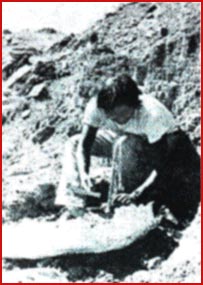 The Dispatch understands that the site was first
discovered some nine or ten years ago, but "the dig" was not undertaken until
Texas Tech could get a qualified man to head the research effort.
The Dispatch understands that the site was first
discovered some nine or ten years ago, but "the dig" was not undertaken until
Texas Tech could get a qualified man to head the research effort.
Dr. Chatterjee is that man.
The Dispatch first published a detailed story on the research effort
August 21, 1980. It had been written by a Tech student and was given full coverage
in this newspaper.
Dr. Chatterjee is assisted in his research effort by his wife, Sibani,
and David Proctor, a Tech graduate student in geology, who accompanied him here Tuesday.
They were on their way to the site for another day of digging.
Dr. Chatterjee explained they start digging about 7 AM and dig until about 2, taking
whatever they find back to the Texas Tech laboratory.
The paleontologist said that an estimated 180 million years ago, during
the Triassic Age, there was a great river through this region and the prhistoric animals
lived along the banks of the river.
Some 110 million years later, or 70,000 million years ago, this area was a sea, he added.
Dr. Chatterjee's dig is approximately 50 yards long and 10 yards
wide.
According to the Dispatch's story
last year, this large meat-eating reptile he has found has a rotary-joined ankle unlike
the hinged ankle of dinosaurs, but this is their only basic difference.
The Postosuchus are a relatively new form of reptile discovered
in Brazil, Argentina, East Africa, Switzerland and perhaps China. Fragments of this
reptile were first reported in North America in 1979 in Wyoming, and the next year here in
West Texas.
Unlike other rauisuchids found so far, however, these near Post
were bipedal - they walked semi-erect on their hind legs not unlike the late Tyrannosaurus
rex.
Where the team is digging - a formation known as the Dockum rocks
- is one of only four late-Triassic paleontological sites in North America.
The other three formations are the Chinle rocks in Arizona, and
New Mexico, the Newark group on the East Coast and the Chugwater rocks in Wyoming.
The Triassic was the crucial period of vertebrate evolution when
reptiles past their evolutionary peak had evolved into various rather specialized lines,
Dr. Chatterjee said.
Along these lines may have been the ancestors of crocodiles,
dinosaurs, birds and mammals. A full understanding of West Texas' Dockum fauna will
from a sounder basis for establishing this evolutionary succession, he said.