|
The Story Continues,
History of Post, Texas
C.W. Post had his own ideas on philanthropy. He said, "the welfare work I believe in is that which makes it possible for man to help himself, but does not include holding the milk bottle after he is weaned." This was his philosophy behind building Postumville, the town he built for his workers, and was soon to be the same philosophy he followed to build his farming community, his oasis in the desert on the plains of West Texas.
|
In the fall of 1906, Charles
employed a Texas rancher, T.P. Stevens, to look over some ranches for him in West Texas.
Post bought 213,324 acres of land, including 333 square miles of Garza County, on which he
was to build his town.
As C.W. Post became more
active in political and labor activities, and with his daughter going to private school in
Washington, he set up a Cabinet of management to handle his affairs in Battle Creek, as
well as his affairs in Texas.
His Texas affairs manager was
H.C. Hawk. Hawk was responsible for stocks, bonds, real estate and supervision of the
Double U Ranch beginning in 1906. His other control included, Canadian Postum Cereal Ltd.,
Grape Nuts, Enquire Publishing Company, Home & Fireside Magazine, Young Fuel &
Pure Ice Company and a labor publication known as Square Deal.
It seemed as though anything
he touched turned a profit. All but one, that is, Elijah’s Manna. It was introduced
in 1906, as a prepared breakfast food. The name in itself was to cause him much grief and
anguish. The American religions accused Post of sacrilege. Though he protested, he was
forced to recall the product and repackage it under the name of Post Toasties. Post
Toasties made him a net profit of $2,185,820 in 1908.
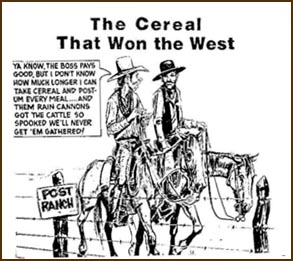 |
The Cereal that Won the West Charles William Post, a Texanized Yankee with a nervous stomach, not only rewrote the breakfast of the nations but he changed the geography of his adopted state. His monument is the town of Post, built on the edge of the Staked Plains caprock escarpment, with money he made by inventing a coffee substitute called Postum and a cereal made for corn which is known as Post Toasties. Mr. Post paid high wages, with good working conditions, and encouraged his cowboys to become land owners by loaning money at low interest, but when he tried to improve their health by ordering the cook to serve Postum for 10 days to wean his ranch hands away from that staple of every cowboy's diet, coffee, the cowhands threatened to ride off the range. After a couple of days he relented and again served coffee. Post firmly believed that coffee was poison. |
After his many other interests were
attended to, Post was able to direct more attention to his Texas venture. His idea of
relaxation, to restore his health was to travel, which in turn was actually work. His true
relaxation was personal involvement in physical labor. His dream town in Texas, Post
City, would eventually lead to the final breakdown in his health.
His dream was a community in which
a family could acquire a home with low money down and low monthly payments. But as stated
previously, he did not believe in a handout, he believed the purchaser should have the
means of self support, after the purchase of their home.
|
He felt that the state of Texas had this to offer. It had plenty of land, wide open spaces
and agricultural potential, land and resources for raising cattle and a sparse population,
at the time. This would be the ideal place for his colonization dream. February 6, 1906,
along with his wife and his daughter Marjorie, and son-in-law Ed Close, and T.P. Stevens,
they made the trip to the Western Plains of Texas.
They traveled by rail as far as
fifty miles South of Wichita Falls, and the rest of the journey was made by hacks and
springboard wagons. The high plains of Texas are noted for their unpredictable weather,
and on this trip the weather showed just how ruthless it could be.
A blue northern came through
as they were partly through their journey. A "Blue" can prove disastrous for
those caught without shelter or protection. Driving cold winds and freezing rain could
create a life threatening situation in a matter of minutes. Just as things began to look
their worst, a tiny shack appeared, which turned out to be a corn storage bin.
As luck would have it, there was a
little stove off to one side. There was no wood available, but it did contain plenty of
corn cobs, which they fed continuously to the stove during the night. After surviving that
bleak night, and the passing of the storm, Charles insisted on looking up the owner the
next day and paying him for the corn and the use of the bin.
After they arrived at their
destination Post made contact with the owner of the Curry Comb Ranch and other lands in
the area. The deal was made and the land was purchased in February, 1906. According to an
article in the Kalamazoo Enquire, March 15, 1906, Post is quoted as saying in part,
"After inspecting the lands and returning to Fort Worth, Ed Close and I inspected the
agent’s report and bought the well known Curry Ranch of 112,000 acres and another
adjourning 50,000 acres."
He continued, "It is 75 miles
from the nearest railway headquarters, but we are going to push the railway through the
property." He did not at that time, for whatever reason, reveal to the public his
intention to build his city. By the end of the year Post had acquired a total of nearly
250,000 acres.
One of the first orders of business
in setting up his new town was the formation of a company to run his affairs in this
venture. He named the company, The Double U Company (the name’s origin is said to
have been derived from Post’s thought of his town becoming a "Double
Utopia"), and its first manager was W.E. Alexander. Post began his venture with
$50,000, of which he controlled $49,600.
His plan for an experimental
community had been many years in the planning. The first seeds of idea are said to have
sprouted during his trip to Texas while recuperating from his mental breakdown. He knew
finding people to purchase his experimental farms would not be hard. The problem, he felt,
would be keeping the undesirables out. To help eliminate this problem he relied on his
secretary and most trusted employee H.C. Hawk.
The time had finally arrived to put
his plan into action, and in 1907, Post headed for Texas. He and "Uncle Tom
Stevens" boarded the train. Stevens stopped in Kansas City to purchase
"big" mules for the arduous freighting operations that would be needed for the
thousands of tons of supplies to build the town. The nearest railhead was Big Spring,
nearly eighty miles across the harshest terrain that Texas had to offer. Stevens and
seventy-two mules safely arrived in Big Spring in early February, 1907. Post made a stop
in South Bend, Indiana, where he purchased two dozen freight wagons and a hundred sets of
harness to complete the mule train hookup. They labored for over a month in Big Spring
preparing for the journey.
The route that was decided on was
to be by way of Gail and Tahoka, a trail that was scouted previously. The trail was rough
but passable as long as the weather was cooperative and the loads were not overly heavy.
The wagons were loaded to heights never before witnessed, the mules wore new collars,
leather harnesses and bridles with heavy leather blinds to deter them from panicking along
the steep drop-offs. The shiny red wheels on the new green wagons glittered in the
sunlight as the word was given to "move out". The outfit moved slowly northward
up the long grade of the Caprock and toward Post’s utopia. This was the first of what
was to be many trips to the promised land.
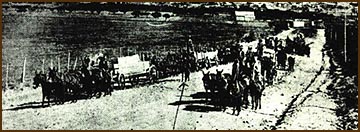
WAGON TRAIN
Hauling lumber to build the City of Post. Leaving Big Spring, 1907
Post did all he could to ease the strain of the journey. He had roads repaired and freight
stations built to comfort the mule skinners along the trail. He was mindful of both the
men and his beasts of burden. He ordered that plenty of food be kept on hand for the teams
of mules as well as the men.
Even with the road repaired it was
still too poor to handle extra heavy loads of freight. An alternate route was scouted and
located by an engineer sent by the board, a man named C.A. (Chief) Marchoff. The route
chosen was through Snyder. Brush was cut and trees cleared to a spot twenty miles
southeast of Post City. From there it followed the Caprock to Fluvanna. Finally a road was
blasted up the Caprock to Post City. Eventually the county and the company collaborated
and the roads were made into passable condition.
Before the arrival of the first
mule train, there was nothing but the stakes Post had driven in the ground marking the
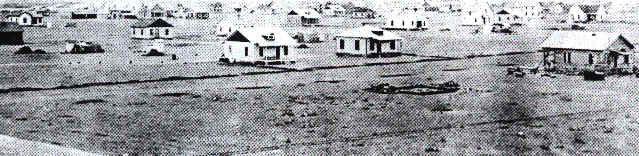
site of the proposed town. Alexander went to work immediately. He erected twenty tents to
house the workmen and one large tent for cooking and dining. Workmen were recruited from
nearby towns and ranches or sent by Post from Battle Creek. Thirty five houses were
finished by the end of May. The plots were marked off in 80 and 160 acre sections. The
homes were all being constructed on the corners of the adjoining properties. Post felt
that this would help to relieve the loneliness of the women on the desolate plains. This
later proved to be nearly disastrous and the homes were moved to the center of each
property.
The first
concrete block building to be erected was the commissary store. The massive building
spanned a length of thirty feet by fifty feet. Next came the workmen’s dining room,
kitchen, office buildings and three residences. A two-story planing mill run by a gasoline
engine was built to prepare lumber.
An urgent message was sent by the
board to Battle Creek. On May 10th, Alexander wired Post that Garza County had
recently been surveyed and the geographical center of the county was found to be eight
miles East of the town. The laws of Texas required that a county seat be within four miles
of the center of the county. Post was determined to make his town the county seat. Putting
all other business aside, Post rushed down from Battle Creek on May 19th to
scout a new location. He found a spot within the four mile limit, three miles from the
Caprock. The final site for Post City had been found. The abandoned site, Close City, also
known as Ragtown, (because of all the tents), was abandoned. He ordered the entire town to
be relocated to the East of the commissary. This new location was in the breaks country
below and two miles East of the Caprock.
All supplies, movable
buildings and materials were laboriously moved to the new location. On blasting a trail to
enable the supplies to be moved down the embankment of the Caprock, Alexander discovered
what was to become an important commodity in building the new city. A large deposit of
white sandstone was discovered. Not wanting to alarm Battle Creek to soon, the discovery
was kept quiet until a quantity of the material was acquired. Post was then notified of
the discovery and he immediately instructed the Double U to use the find in the
construction of the first rock buildings in the town. Considering the distance building
supplies had to be hauled, the quarry was an important discovery.
 |
On
July 7th, 1907, a vote was taken and Post City was proclaimed the county seat
of Garza County. The scene of the settlement was a vast prairie, eighty miles from the
nearest railroad or civilized settlement. The roads were mere trails, there were no
bridges to cross the streams and stubborn mules and horses were the sole means of
transportation. To Post it was a challenge. He hired more laborers and forged on.
By June a planing mill had been
erected, a shed for storing cement, a blacksmith shop, and a workroom for carpenters had
all been completed. By April, 1909, forty carloads of materials from Beaumont had been
shipped to Post City. Construction was progressing at a near frantic pace. The first of
many rock buildings to be erected was a company building that would house eight stores.
Two Scottish stone masons, George and Charlie Sampson, along with Jimmie Napier were in
charge of the masonry construction. Napier, a friend of the Sampson brothers, arrived in
Post City directly from Scotland.
Post would not tolerate shoddy work
and he paid close attention to all work and machinery around him. He arrived in Post City
in November to observe the construction first hand. He took much pride in the size and the
beauty of what he was building. While visiting Post City in June, the finishing touches
were being added to the store building. With his usual deportment he gave specific
instructions on how the first elevator in West Texas should be installed, along with a few
windows and doors. He left no detail to chance, no matter how insignificant is might have
seemed.
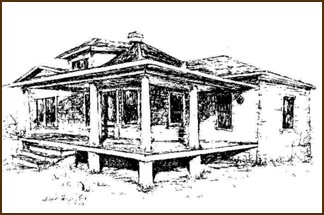
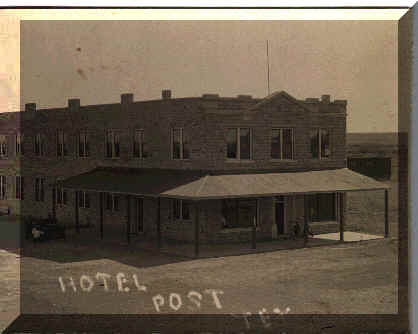
By 1907 over 300 prospective residents had answered Post’s call to his city. People were arriving faster than housing could be constructed. The bungalow style homes could be built in as little as 11 days, but a place for the visitors to stay while they surveyed their properties was sorely needed. A hotel was to be the answer, one that could offer the visitors comfort and style. Post sent precise plans for the construction and supplying of the new hotel. The Algerita Hotel, named after a desert shrub, was soon to be the talk of the West. The doors were opened for business in July, 1908.
|
The hotel had 30 rooms, good food,
lavish furniture and beautiful paintings. The linens were to be changed after each guest.
Postum and Grape-Nuts was to be placed in covered dishes on each table in the dining room.
As in all his endeavors, Post demanded perfection in his hotel.
Other native stone buildings to be
erected were a restaurant, rooming house, planing mill, office building, paint house and a
machine shop. All were constructed with native stone from Alexander’s Quarry.
Drug stores, grocery stores, lumber
yards and all other necessary stores began to appear on the horizon. Post drafted a set of
guidelines to be followed by all businesses. One rule he demanded be followed strictly was
no liquor. If any alcoholic beverages were found being sold in any of Post City’s
establishments, the establishment was to be closed down immediately.
To make a
connection with the outside world, Post ordered a fast traveling, light weight mail and
passenger hack to be put into service between Snyder and Post City twice a week. He
instructed that twenty light mules be trained for the job. Four were to be on each of the
two hacks from Post to Fluvanna and the same number from that point to Snyder. A reserve
of two were kept at each end of the run.
The town of Fluvanna had been the
shipping point to Post City by this was not to remain so for very long. The Santa Fe was
building South from Plainview to Lubbock. The road to Lubbock, though ten miles further,
offered an alternate route. The terrain of level and high plains was much easier to
traverse, and much safer. It seemed only logical to Post that a road be constructed from
there on to Lubbock.
In September, 1909, Post wrote that
he was shipping a large load of water pipe to Lubbock by way of the Santa Fe. The
freighting charge from Lubbock to Post City was five cents a hundred weight cheaper than
the rate from Fluvanna. Post got in touch with the Vice President of the Santa Fe, W.B.
Story Jr. And gained his cooperation in making deliveries as close to Post City as was
possible for the time. In the beginning, the Santa Fe was asking that the Double U build a
side track or a weight station at Beresford Siding. Finally, however, it was agreed that
the company was under no obligation to do so and Beresford Siding began receiving carloads
of freight destined for Post City. The railroad was finally completed into the city on
November 18, 1910.
On December 22, 1910, it is
recorded, the company received twelve carloads of freight by rail, into Post City. The
first passenger train steamed into a turbulent and festive welcome on January 15, 1911.
The entire town and country folks alike turned out for the occasion.
The trip up and down the Caprock was steep. The earlier TransWorld powered by steam,
lacked the power to back up the grade so the trains were required to back into Post City
to enable them to have a straight forward pull at the hill. Work continued feverishly to
complete the Post City station. Soon new freight depot, a passenger station, switches,
side tracks and a railroad yard were finished by the end of January. But, it did not stop
there. The Santa Fe was building a line from Coleman through Sweetwater and Snyder to
connect with the Amarillo-Post City line. Post City was not only connected to Lubbock and
point s North, it was connected directly to the national lines. The gap that had created
such isolation for the city had been filled.
After the arrival of the Santa Fe,
people began arriving in Post City in as many as 11 immigrant cars per day. Poor
communications with the outside world was no longer a problem. The old freighting days
were gone. Mules and wagons were replaced by railroad cars. The city was no longer a wide
spot on a desolate trail.
In 1906 there
were less than 200 people. By 1907 over 300 had arrived and by 1908 the population was
almost doubling by the year. The quest for water in the semiarid plains was sure to be a
major stumbling block. In the beginning, water was hauled from atop the cap where a
producing well had been drilled by Alexander in May, 1907. The only water on site in Post
City was from cisterns built to capture the infrequent rain fall. Small tanks and lakes
furnished water for the stack. At C.W.’s order a well was drilled in town to a depth
of over 250 feet, but with negative results. Teamsters kept water wagons moving in and out
of the town both day and night. Water was needed for both drinking and for the mortar in
building the township.
The water problem had to solved if Post City was to continue to prosper. Alexander made a
futile attempt at piping water into Post City with a makeshift pipeline from Keith’s
Spring. This produced only two gallons of water per minute. He later referred to it
sarcastically as Alexander’s "Pet Spring". Post arrived in Post City to
take charge. He concluded that an abundance of water could be piped from atop the Caprock
to the town site by way of wells and gravity. Windmills would extract the water from the
ground and the steep slope of the Caprock would provide the necessary power to bring it
into town.
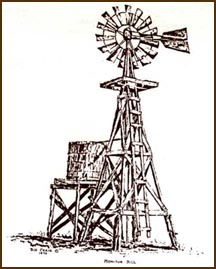
He ordered Alexander to drill
fifteen or twenty wells on the High Plains, a mile and a half South of the Commissary. The
first water works sent the supply of water into a reservoir, but it was obvious it could
not be used for any length of time in fear of contamination, and was therefore only a
temporary measure. Even with the eighteen foot windmills pumping as fast as the Texas
winds could turn them, the water supply was inadequate. Post sent orders that a ten foot
diameter, brick lined well be dug. The eighty-plus foot well when completed held over
fourteen feet of fresh water. A new rock and masonry reservoir was built and a gasoline
engine furnished the power for the pumps that were capable of delivering over one hundred
gallons of water per minute. Along with the giant eighteen foot windmills on seventeen
wells still proved to be inadequate. After several reservoirs were built or moved and
dozens of more wells drilled, a check for $29,000 from Post was still needed to finish all
that was needed to provide an adequate water supply. The water works was completed in
1912.
Mr. Post grew
up around greenery and wanted this for his model town. He concluded that he would build an
ideal town and rural community where flowers and trees would bloom in the desert. He
envisioned orchards, fruit trees and yards well stocked with roses and other flowers. This
was apparent very early on, in clippings he sent to his manager, W.E. Alexander form the Kansas
City Star as early as 1907. He ordered trees be planted thirty feet apart for a
distance of two miles on each side of the highways leading in and out of Post City. He
ordered parklets or plots on downtown streets and a large park to be landscaped South of
town.
Post sent specific plans to Post City as to how the homes and farms were to be built. He
wanted to experiment with the trees, fruits, vegetables and other things that would be
needed to sustain life on the farms. If the tenants could not make a living they would not
be happy and therefore would not make good tenants.
They were to have three acre
orchards, vegetable gardens, grapes and the necessary fencing. But before putting the
farms up for sale, Post felt that he might as well carry on some detailed experiments in
farming in the area, since he was in no particular hurry anyway. For the next seven years
Post carried on extensive and detailed experiments. Alexander was put in charge of the dry
land farming. He had previous dry land experience, growing vegetables and various other
crops that Post was interested in. Forty farms were built on the plains with corn and
several varieties of vegetables planted. Low yields were harvested and the reason was
excused by Post as being Alexander’s northern way of planting. In reality he had not
mounded the rows to enable the water to soak into the crops.
In addition to the standard crops -
corn, cotton and oats - Kaffir corn was planted. Milo, Sudan grass, cow peas, wax beans,
broom corn, peanuts and hundreds of others were also planted. Rainfall for the season was
average. The harvest for 1908 was better than expected. Two mouse-proof bins had to be
built to hold the surplus. After years of experiments, both successes and failures, it was
decided that red Kaffir corn and cotton were the hardiest and were best suited for the
area. Plowing was also experimented with. The more deeply plowed areas yielded more that
three times that of the shallower ones.
By the spring
of 1909 the fruit trees he had planted had begun to produce fruit. When the farms were
sold it became the responsibility of the new tenants to care for the orchards and gardens.
Many of them neglected to do so. As the residences were sold, the ground was broken up,
Bermuda grass, roses and many other flowers were planted. In an effort to induce tenants
to maintain them a cash prize was offered for the best yards.
Homes in the city were built in
four classifications: one, two, three and four bedrooms. Prices ranged from $800 and up,
depending on the home and its location. Most were built in the bungalow style that Post
was so fond of, though some had rock lower walls and stucco. All were offered at low down
payments with low monthly payments.
Colonization of the town was
proceeding at a rapid pace, but the farm colonization was much slower. Massive nation wide
advertising campaigns were started. Distribution ranged from as far West as Washington
state to as far East as Washington DC Because of the slow rate of sales, he decided more
improvements were needed on the farms. Wells were dug, fencing was erected, sheds were
built and animals were stocked in many. Still the farm sales did not keep up with the town
sales.
He finally decided to completely
change his approach. He would rent the farms to people who might eventually want to by
then, then improvements would be made an the land tilled, increasing its value and appeal
to the tenants. Full page ads were taken out in several papers advertising the lease of
the farms. The ads offered farms to be leased at low rates for five years which could then
be purchased at a cost that was agreed upon in the beginning. Letters began arriving at an
alarming rate.
Special fares were arranged with
the railroads for prospective colonists going to Post City. They were met at the depot and
driven around to the various lease farms and homes. They were treated like royalty. The
farms that were not rented were farmed by Double U employees to ensure that properties
were kept up.
Post City had finally begun to
really grow. Schools were started in two homes in 1908, a Volunteer Fire Department was
formed and a baseball team organized for the amusement of the men. In 1909 the girls
organized a basketball team and the ladies formed a sewing circle which met on Wednesdays
in the hotel. The ladies from the farming communities started a literary society. Churches
met in homes and other buildings. Post City had gained a social life.
In the
beginning, Post owned and operated all of the businesses in Post City. It was his
intention to establish them and as residents arrived they would be sold or leased to
private individuals. Post’s favorite business in his dream town was the hotel. But
the hotel lost money from the start. Finally, in 1913, a young couple by the name of W.E.
La Fon and wife took over management of the hotel. By December of that year they were
doing so well that the board raised their salary. The following March, J.K. Witt took over
and the institution continued to at least break even.
One other white elephant was the
laundry. It was hoped that the laundry would draw customers from Tahoka and neighboring
communities. As it turned out the equipment was all either too large or too small to be
effective.
Another business that contributed
to their trouble was the company store. The store sold everything from windmill parts to
food goods. One section was cordoned off and served as a drug store or apothecary.
Needless to say the bookkeeping in a business selling such a wide variety of merchandise
was a nightmare. Eventually the books were balanced and a new, simpler system put in
place.
Post originally planned on selling
the large store, with its eight different sections to one individual as a package deal.
They were eventually sold separately. One be one as colonists arrived and purchased the
businesses, the Double U was free of their merchandising enterprises.
Communication with outside
communities was a major problem. In the beginning, a telephone line was run to
Clark’s ranch, southwest of town. This line connected them to Snyder, Colorado City
and Fort Worth. A few weeks later a line was run to Tahoka, by way of pasture fences. It
worked nicely as long as the wind did not blow and it did not rain. By December the wire
had arrived and poles and proper lines were installed. Switchboards were purchased and a
building built to house the new telephone exchange. The Garza Telephone Company operated
until 1919, when it was sold to Southwestern Bell.
A bank was needed for the new
community. The First National Bank of Post City was opened with capital stock of $50,000,
of which Post held 26,000 dollars, the controlling interest. H.B. Herd was made president
and W.O. Stevens cashier.
In 1910 the Double U Company had
built 59 new homes in town, all of which were sold. Other buildings erected the same year
were a two story office building, a Masonic lodge, a school building, a church, a grain
elevator and a movie house. In April, 1909, Post sent plans for a cotton gin to be built
in Post City. The gin buildings and warehouse were completed in September. Enough cotton
was ginned to keep the gin busy, but not all year around. Post decided another enterprise
was need.
A cotton mill seemed the most
logical choice. Construction began in February, 1912, and continued for more than a year.
The total floor space for the Postex Cotton Mills gigantic buildings was over 136,000
square feet. The power house was equipped with three 300 horse water boilers and two 450
horse Corliss engines. The influx of people and jobs strengthened the community and added
more stability to the town. The mill was the first in the nation that would take the raw
cotton from the fields and turn out the finished products. Garza Sheets soon became known
for their high standard of quality nationwide.
Post’s
experiments had made him a wealthy and somewhat noted man. But none of his previous
experiments come close to matching the one he was about to try. Post was in Texas during
the 1800s when rainmaking was in its heyday. Congress had appropriated $9,000 with which
General H.E. Dryenforth of the U.S. Army, carried out rainmaking experiments in Midland,
Texas. Gunpowder and balloons filled with gas were set into the heavens and ignited. In
sixteen days of explosions he got three heavy rains and nine showers. Post figured that if
he could make it rain when and where he wanted it to he would go down in history as the
greatest inventor in the world. He could remember tales of rain resulting after great
battles, such as Napoleon’s battle days, and the talk of the Civil War veterans and
their stories of all the rainfall following intense cannonading.
Post’s first rain experiment
was in 1910. Two pounds of dynamite was flown into the sky and ignited in the clouds.
After the first experiment, Post deemed that the kite method was too dangerous. Later,
fourteen pounds packs of dynamite was spaced fifty feet apart for a quarter mile and
lighted on the ground at ten minute intervals. In one battle, as he liked to call them,
3,000 pounds of dynamite was ignited in 1,500 shots. Rain fell almost immediately.
In 1912 alone over 24,000 pounds of
dynamite was exploded in an attempt to produce rain. A slight rainfall was reported in
Crosbyton, Slaton and Post City after one such battle. The experiments continued through
mid 1913, but when rain became plentiful the experiments were halted.
By 1910, other necessities could be
attended to. Dr. A.R. Ponton first arrived in Post City in that year, and experimented in
socialized medicine. Post was so pleased by the citizens response and by the doctor’s
idea that he assisted by purchasing medical equipment.
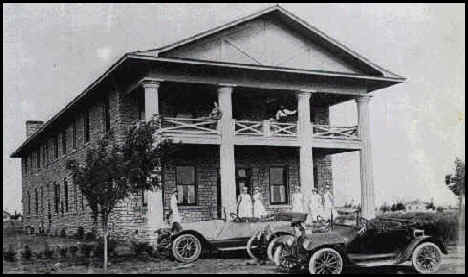
POST SANITARIUM later to become the Garza County
Historical Museum
The next step
came when plans were made to erect a two story building to be used as a sanitarium. Plans
for the building were begun in 1911 and construction began shortly after. It was a
beautiful building with large pillars supporting a second story porch. It had a basement,
an elevator and six bathrooms. The Ponton Sanitarium opened for business in 1913. It was
billed as the best medical facility in the West. Dr. Ponton is said to have performed over
a dozen operations almost immediately after the doors opened. A nurses training center was
started, making it the only one West of St. Louis.
The hospital operated
successfully until World War I, when all the young doctors were called to service. The
Sanitarium closed its doors as a medical facility in 1918. Dr. Ponton moved to Lubbock
where he opened another sanitarium that would later be called Methodist Medical Center.
The Post City Sanitarium is now the Garza County Museum.
Post had strong
feelings that a large deposit of oil lay buried beneath the soil of the South Plains. He
hired a geologist from the East to come to Post City and ascertain if the oil existed. The
geologist confirmed Post’s suspicions and preparations for oil well drilling began in
1910. A steam boiler was moved into Post City in an attempt to find the elusive black
gold. All of this was done before the coming of the railroads.
After Post was notified of the
defeat, and the expenditure of over $20,000, he put a halt to the project. Ironically, if
he had drilled a few hundred feet further into the second hole he would have discovered
one of the largest oil deposits in West Texas.
By this time the growth of the town
had slowed its pace. Post felt that now what was needed was entertainment to ease tensions
and bring unity to the city. Two Draw Lake was constructed two miles from town as a place
for swimming and barbecues. It was billed as an oasis and attracted people from across the
region. The lake soon became the site of an annual July 4th celebration.
As Post weaned the community of
total reliance on him, he retreated to his Santa Barbara home. He was feeling once again
in pain and totally exhausted from the constant stress of his incredible work load. In
1917 the town population was over 3,000, but sadly, C.W. Post never lived to see his dream
completely fulfilled.
The first
indication of the severity of Post’s ill health came when he canceled a speech he was
prepared to deliver against President Woodrow Wilson in New York, condemning the new
income tax law. The speech was given instead by Charles Dunn, a New York lawyer. His
failure to deliver his speech waved a red flag to the press. Post’s fragile health
was failing. Then in January, 1914, a Chicago newspaper ran headlines on page one saying,
"C.W. Post has broken down from overwork and mental strain". From January to
March, his health tittered from pain to depression and despair.
Finally, in March, newspapers
across the country reported, "Michigan Millionaire Races With Death Across the
West." A nonstop train ride in a private car had been arranged by the president of
the Santa Fe Railroad, from California to the Mayo Clinic in Rochester, Minnesota.
His daughter, Marjorie, and his
parents rushed to Rochester to be by his side. On March 10, he was operated on for acute
appendicitis. The operation was a success, and he was released from the hospital and was
allowed to return to California to recuperate. His recuperation went satisfactorily, until
May 9, 1914.
The 59 years
and 7 months of C.W. Post’s Earth tenure covered a period in American history which
encompassed the maximum of startling events for a like period of time.
As a lad, Charlie Post stood on the streets of Springfield and watched the return of Civil
War Veterans. He saw his father act as a member of the honor guard to bury the Great
Emancipator. The golden spike, linking the first transcontinental railroad, was driven
when Charlie was 14, and he was just five years of age when Drake drilled the first oil
well in Pennsylvania. Edison’s phonograph and incandescent lamp were forerunners of
singular significance. The Wizard of Menlo Park excited the populace again in 1893 with
the Kinescope (the beginning of the moving picture). The Curies made announcement of their
discovery of radium in 1898. The Wright brothers got their flying machine off the ground
while Henry Ford was endeavoring to take the world off it’s feet. The tunnel under
the East River in New York, 1908, was an engineering feat of great consequence. The first
ship-to-shore wireless, the Panama Canal Act, Alexander Graham Bell’s inventions,
discoveries of the North and South Poles, the dedications of the Bartholdi Statue of
Liberty and the Washington Monument, were events well remembered by C.W.
He stood tall in the middle of a
great era. Those were the days of "moving forward" in America, the age that
founded the great fortunes which have established the economic possibilities for the new
frontiers. Just one month after C.W. Post’s death an Archduke would be shot in a town
whose name most American could not even pronounce, an incident that would involve America
in a "War to end all Wars". A new phase would begin in America, change the mode
of living, step-up the immense industrial potential and evolve a whole new pattern. A
great era and a great man would end their cycles almost simultaneously.
C.W. Post left behind him many
monuments in the hearts of men, and to the future he left a daughter carved in his own
image who would carry on in benevolence and love of humanity. Marjorie Merriweather Post
was 27 when she inherited a fortune and became the owner of a thriving business. Unlike
many such beneficiaries, she was to increase and expand her inheritance and do much good
with it.
from POST, TEXAS, The Gateway to the Plains
References:
C.W. Post, The Hour & the Man
by Nettie Leitch Major
C.W. Post, The Man - The Legend
by Bill Galusha
Other references of interest:
Post City, Texas
by Chas Dudley Eaves & C.A. Hutchinson,
Is an excellent account of C.W. Post and the complete story of the colonization of Garza County