Monday - August 13th: Return to Itasca
Monday - August 13th: Return to Itasca
In 1978, at the tender age of 25, I made my first trip to Minnesota—specifically the University of Minnesota's Biological Station at Lake Itasca. It was there I was to spend 6 weeks. Not as a student but as an "Unofficial Teaching Assistant" for a graduate—level class taught by Professors Herb (Warren H.) and Florence Wagner of the University of Michigan at Ann Arbor.
How did this come about?
In 1974 I was rummaging through some books in my dad's library at 616 8th Street in Morgantown, WV. This was shortly after I had moved into the 3rd—floor apartment formerly occupied by my two sisters—Joan and Susan. They always referred to the apartment as the "Serendip," which was short for serendipitous. That was between 1963 and 1968, when we had moved from Wheeling to Morgantown.
At some point during my rummaging, I came across a slim volume, the title of which I was not quite sure how to pronounce.
Paging through it, I found illustrations of plants that were not familiar to me. Although the plants looked different from each other, there seemed to be a common shape to most of them.
This unfamiliarity with these plants may seem strange considering I grew up exploring the hills and dales of Oglebay Park, where the family lived in a park house. The house came with the position of Park Naturalist in which capacity my dad, George H. Breiding, served for 13 years.
But being the constantly on—the—go kids we were, our attentions were focused mostly on things that moved— butterflies and moths, frogs and toads, salamanders and snakes, water skippers and crawdads. And of course—birds.
As children we learned the common plants and could name most of them. But they held little interest for us, as we could not chase them with butterfly nets, get our hands covered in slime, or do battle with giant crawdads, which we chased through the shallow waters of Poughs Run.
Then, in 1963, when we left Wheeling and our beloved Oglebay Park behind, we soon became distracted by "Big City" diversions. Yes, we were leaving that sheltered life behind and moving to the Big City—Morgantown, WV.
Here we would move into a house on a street, not a rural route. And we would be able to easily walk the 1.5 miles to downtown Morgantown and Walter's News Stand for comics and candy bars.
When we lived in Oglebay, we visited downtown Wheeling only once or twice a year. And they were always big events—Christmas shopping, or a visit with Grandma and a trip to the lunch counter at G.C. Murphy for a delicious roast beef sandwich smothered in a rich, dark brown gravy.
Although 6 years of Big City diversions in Morgantown, which were followed by 4 years in San Francisco, did not completely erase all the natural history I had learned as a child, it did much to dampen my interest and dull my memories.
But once I had in hand that slim volume, plucked from a box in my dad's library, those old interests began to be revived.
I can still remember taking that little book to my dad and asking, "What does this word mean?" That word was "Pteridophytes" and the book title was "The Pteridophytes of West Virginia" by Maurice Brooks and A.S. Margolin, published by West Virginia University in 1938.
My dad pronounced the word for me and told me a Pteridophyte was another name for a fern. And with that—a fern lover was born.
That was the genesis of what was to become an intense interest in all things ferny. So much so that I spent nearly all of my free time walking the hills and hollers seeking out ferns. I collected them, pressed them dry, and then mounted them on sheets of heavy paper to make study skins. I dug them up and transplanted them to the yard. In short order I amassed a larger collection of books on ferns, which included the latest edition of Boughton Cobb's "Field Guide to the Ferns," all the way back to "The Ferns of Kentucky" by John Williamson. It was published in 1878 by John P. Morton & Co., W. Main Street, Louisville, KY. I did not know it at the time, but this was the first fern book published in the United States.
Ok. This is getting a bit long—winded. The upshot is, around 1974, on one of my ramblings in the woods, I found a fern I knew to be a bit unusual. After careful examination I was fairly sure it was a hybrid Dryopteris, specifically Dryopteris x triploidia, a hybrid between D. intermedia and D. spinulosa.
At the time there was no one in Morgantown who could confirm this. Professor Roy Clarkson of West Virginia University, whom I had become acquainted with when mounting plants at the Herbarium, suggested I contact a fellow by the name of Warren H. Wagner of the University of Michigan. Roy said he was one of the leading authorities on ferns in the US and had done some work with hybrid Dryopteris.
One evening, after dialing directory assistance for his phone number, I called Herb (Warren) at his home. I asked him if he was the Warren H. Wagner who was the fern expert. He confirmed he was. I then went on to tell him about my fern discovery and my need for confirmation of its identity.
He asked me a few specific questions about it, such as was it fertile, did it have stalked glands on the rachis, etc. He must have been satisfied with the answers because he felt I had indeed found Dryopteris x triploidia. But Herb said he would need to have the specimen sent to him for a closer look to confirm. I told him I would send it on, and then the conversation wound down. He then asked me, "Why haven't I heard about you?" At first I did not know what he meant. Then I realized he thought I was "somebody" in the world of ferns. Imagine my surprise...
I sent the specimen to Herb, and we kept in touch. I pursued my interest in ferns and in 1975 found another Dryopteris hybrid new to the state of West Virginia - Dryopteris neo-wherryi recorded for West Virginia. Later, with John Laitch (and again in the '80s with R. Bartgis), we rediscovered the disjunct population of Cryptogramma stelleri.
Then, at some point I got a call from Herb asking me if I wanted to come to Ann Arbor and join him on a week—long "Fern Survey" of Michigan. WOW! In short order I was on a Greyhound bus and on my way to Ann Arbor. Herb introduced me to many new species as we rambled all over the state looking for new localities of new species and confirming sites for old ones. I guess this must have been my baptism by fire because it led to the invitation to act as the "Unofficial Teaching Assistant" for a 6—week, gradate—level, special topics class in Pteridophytes with emphasis on field biology and cytology at the University of Minnesota's Biological Station at Lake Itasca.
But why "unofficial," you might ask? Well, Herb knew I had only an 8th grade education, and that would not be considered adequate qualification to be the "official" teaching assistant for the class. But Herb must have felt I was up to the task and was able to arrange my stay there for six weeks and be paid with room and board only. Fine by me!
I then spent 6+ weeks with Herb, his wife, Joe Beitel (AKA Selago Joe), and about a dozen students engaged in the intensive, exciting, and fun study of ferns. Upon reflection I must ask, how did this Jr. High drop-out HillBillyRed-Neck get so lucky?!
Ok. Fast forward 34 years to 2012. Here I am again, back in Itasca country with Betsy and Roger, and we are on our way to Itasca State Park for a bit of hiking.
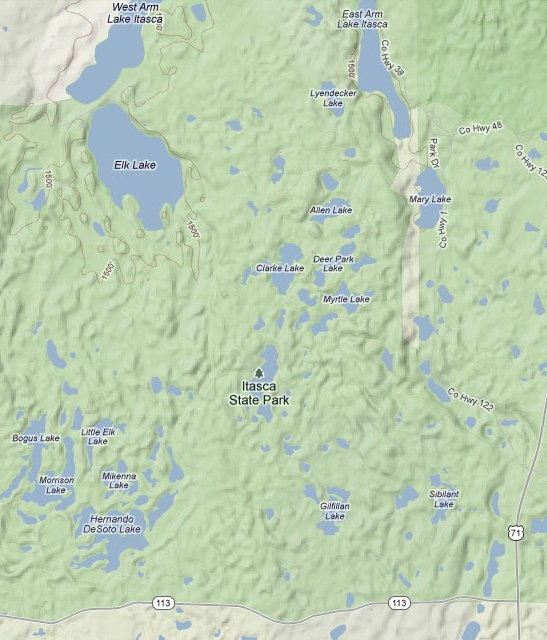
Itasca State Park is about 40 miles east of Roger's place on White Earth Lake. Established in 1891, Itasca is Minnesota's oldest state park. It totals more than 32,000 acres (50 square miles) and includes more than 100 lakes. That is BIG for a state park!
Since I had converted our van into a 2-seater for camping, Roger decided to drive over to where his motorcycle was stored, jump on it, and then meet us at the gas station, where we would then proceed to the Park.
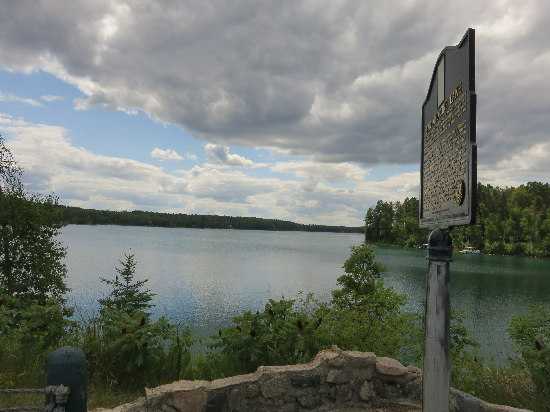
Our first stop was Bad Medicine Lake to have our packed lunch.
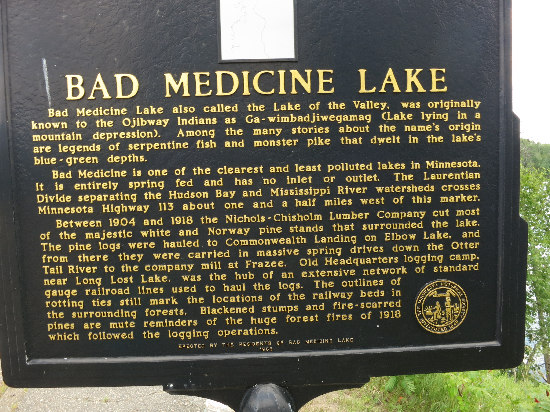
Bad Medicine Lake is a spring-fed lake located in Forest Township in Becker County, Minnesota. It got its name from the fact that early Native Americans in the area thought that a lake with neither inlet nor outlet was a place of bad omen ("bad medicine") and would not hunt or fish near the lake. The lake is approximately five miles long, a half mile wide, and reaches depths of up to 90 feet (27 m). It is known for its clear, cold waters and rainbow trout fishing. It has experienced dramatic changes in its fish habitat and fish community in the last 35 years.
Regarded as a bass/panfish lake in the 1950s and 1960s, the lake is now managed primarily for rainbow trout and walleye. The DNR turned Bad Medicine Lake into a trout lake in 1977, following an explosion of native crayfish that eliminated the vegetation used by bass and panfish. Roughly 16,000 rainbow trout are stocked annually, including Kamloops and Madison strains. There are three active resorts located on the lake. Bad Medicine Resort and Campground is owned by Don Tschudi. Veronen's Resort is a family—owned and operated campground established in the late 1940s by Bill and Gertie Veronen. The second resort is High Pines Resort, owned by Ray and Lynette Vlasak.
class="source">Source: WikiPedia
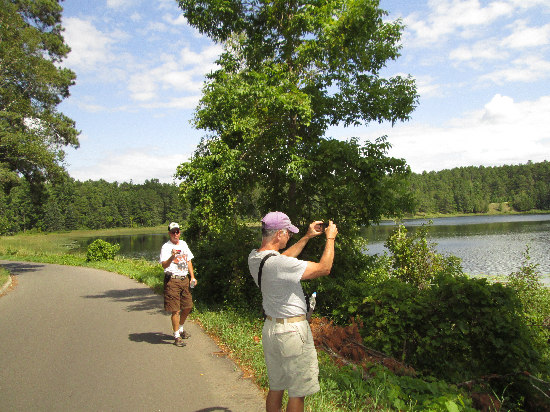
This is what you get when you have 3 people with digital cameras—Betsy taking a picture of Roger taking a picture of me taking a picture. Confused??
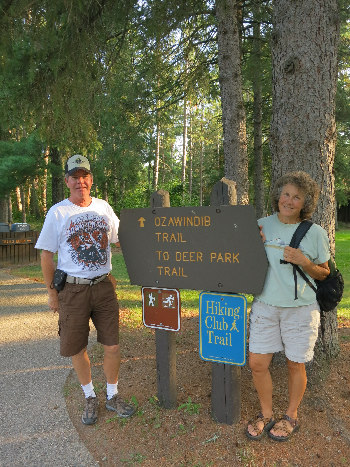
We stopped at the Visitors' Center, got a hiking map, and decided on a 5.6 mile loop hike. My leg was still hurting and swollen from my puncture wound the day before, but I had dosed up on 600 mg of "Vitamin I," and I was hoping that would help.
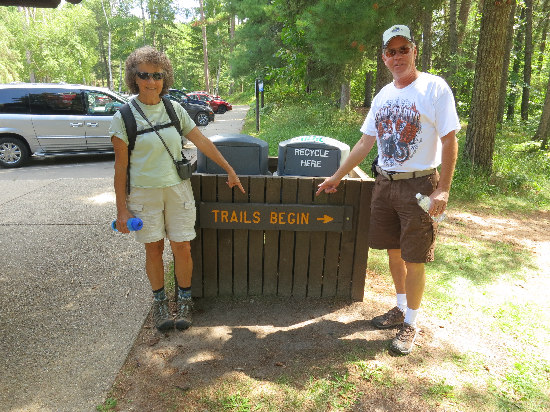
This extra sign made sure we did not get lost. At least not right away.
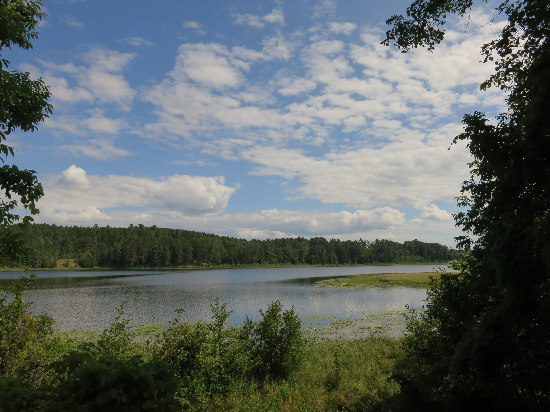
This is Mary Lake, which is named for Mary Hannah Gibbs (1879-1984), the determined woman who risked her life for Itasca State Park.
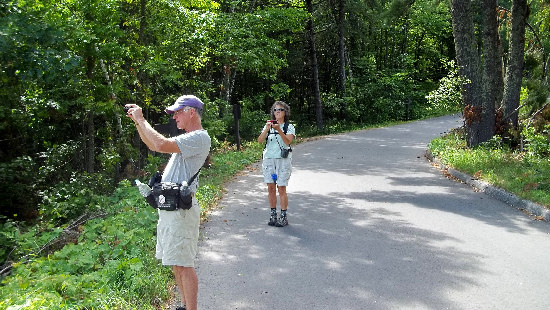
Now Roger gets in on the act!
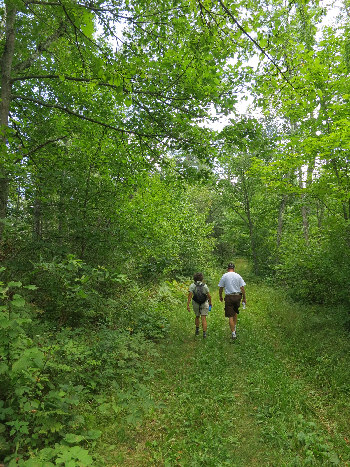
The Ozawindib trail started out as a mowed path through second—growth forest.
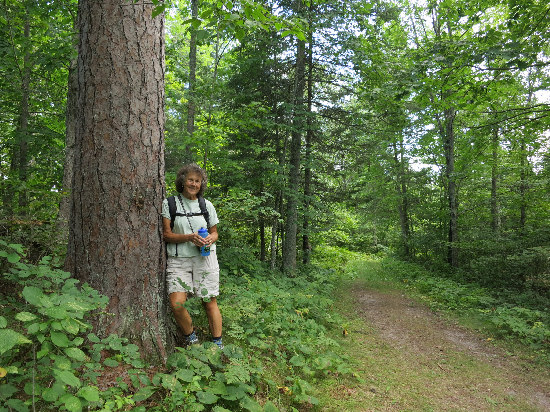
But soon we were seeing the big conifers Itasca is famous for.
Here is Betsy next to a fine specimen of Red Pine (Pinus resinosa).
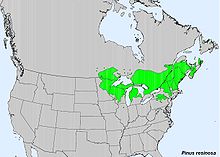
As you can see from the range map above, Red Pine is primarily a conifer of the far north.
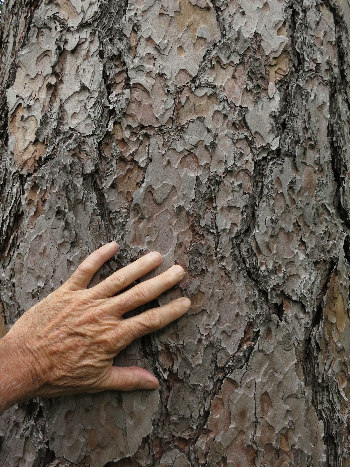
The bark of red pine is very distinctive and, like many conifers, resistant to fire.
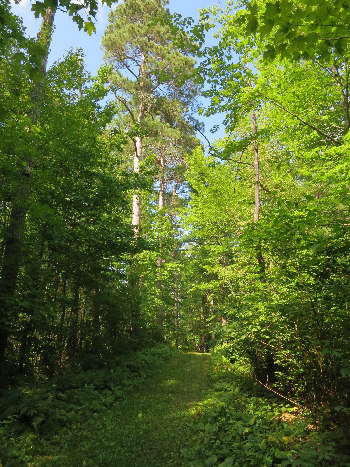
Here you can get an idea of the height of some of the Red Pine.
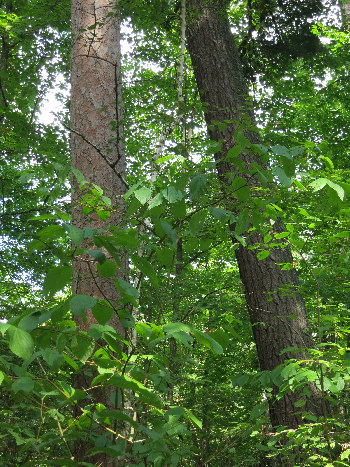
There are also some large White Pine (Pinus strobus) at Itasca. On the left is Red Pine, on the right, the much darker bark of the White Pine makes it easy to identify.
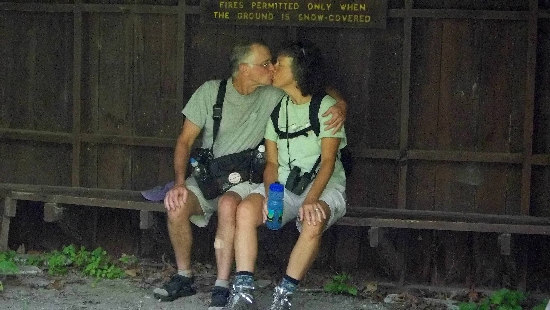
The Ozawindib Trail leads to a warming hut for cross—country skiers. Roger coaxed us until we smooched!
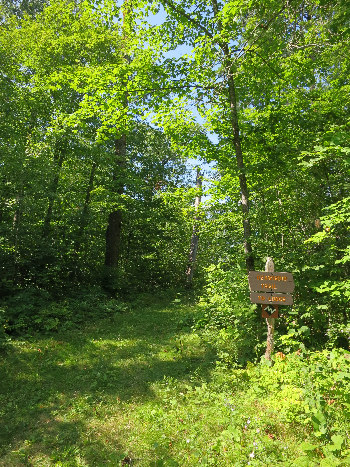
All of the trail intersections were well signed, and most of them appeared to be new or freshly painted.
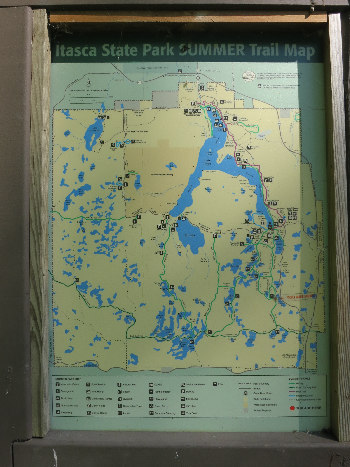
This nice big map was at many of the trail intersections and helped us navigate.
From the ski hut we picked up the much smaller and less well defined. "Red Pine Trail."
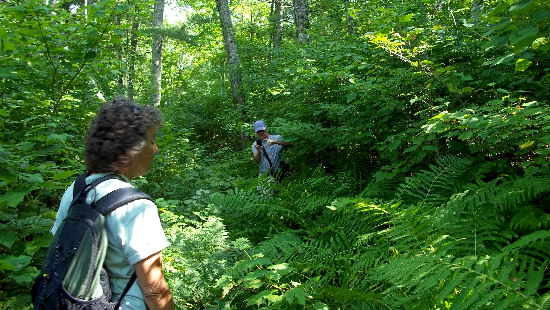
As this picture of Roger's shows, "less well defined" is a bit of an understatement.
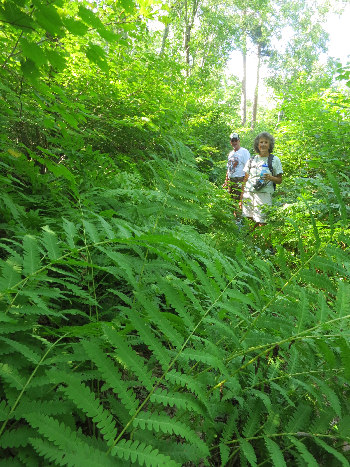
At one point these big Cinnamon Ferns nearly obscured the trail.
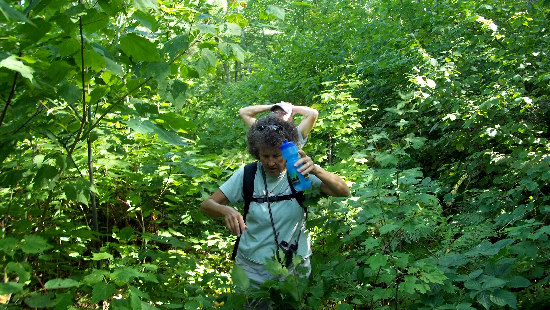
Then it was raspberry brambles that obscured the trail. Check out the look on Betsy's face. She hates bushwhacking! (Good shot, Roger.)
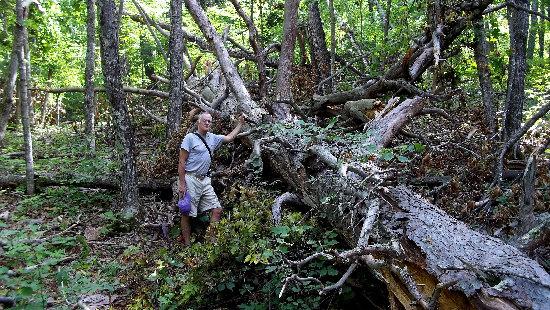
Roger took this shot of me next to the dead behemoth. There was lots of blow-down. Some were old like this, some so recent they still had green needles.
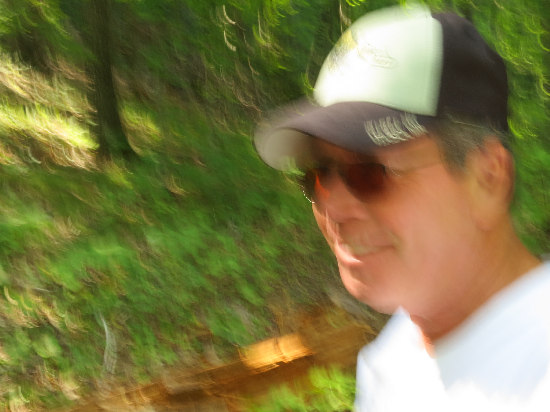
My favorite shot of Roger.
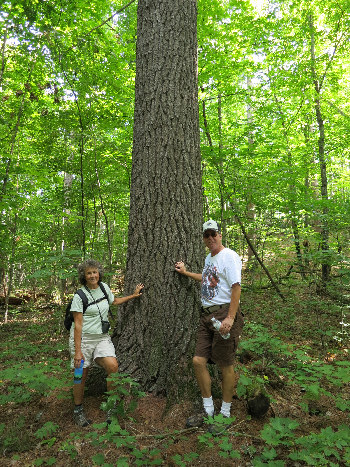
A gorgeous White Pine!
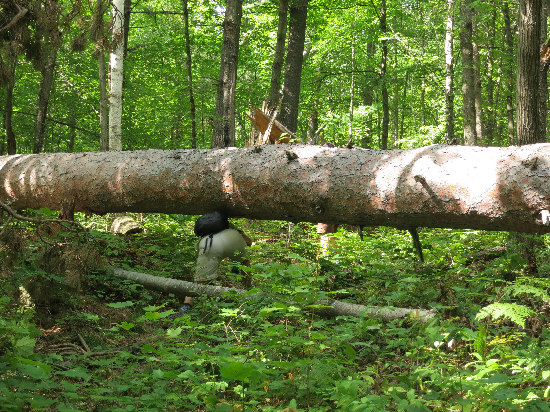
Here, Betsy scrambles under a newly fallen Red Pine. Seeing all these downed giants was heartbreaking.
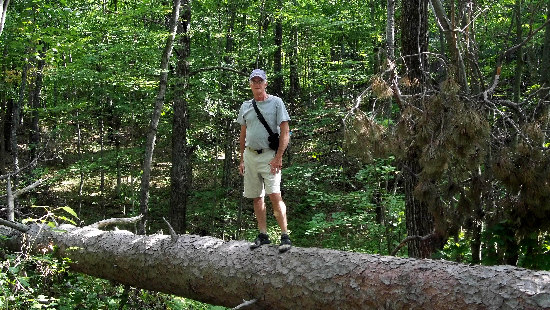
This is me practicing for my role as "Little John."
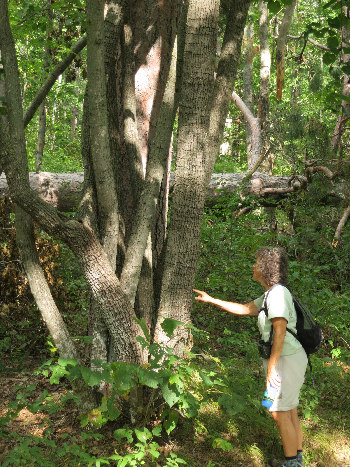
Here Betsy checks out the work of a Yellow-Bellied Sapsucker (Sphyrapicus varius)in this Basswood (Tilia americana)
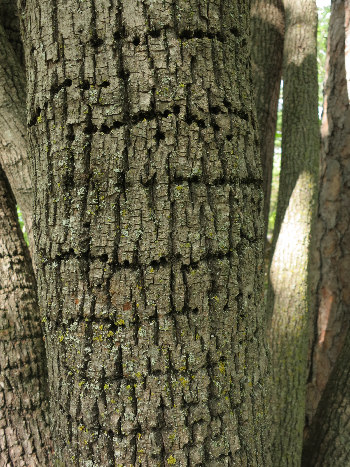
A closer look at the Sapsucker damage on the Basswood.

Like other sapsuckers, these birds drill holes in trees and eat the sap and insects drawn to it. They may also pick insects from tree trunks or catch them in flight. They also eat fruit and berries. Source: WikiPedia
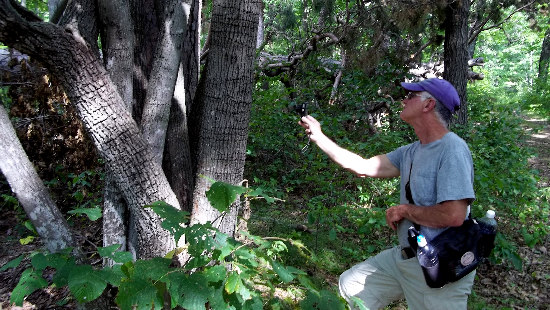
Roger takes a picture of me taking a picture. It still looks odd to me to see anyone taking a picture like this instead of using a viewfinder.
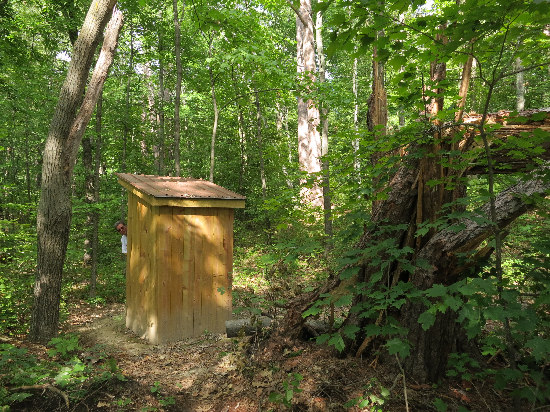
We passed by Myrtle Lake, which had several pack-in campsites. A new outhouse had been built for camper use, and Roger decided to check it out.
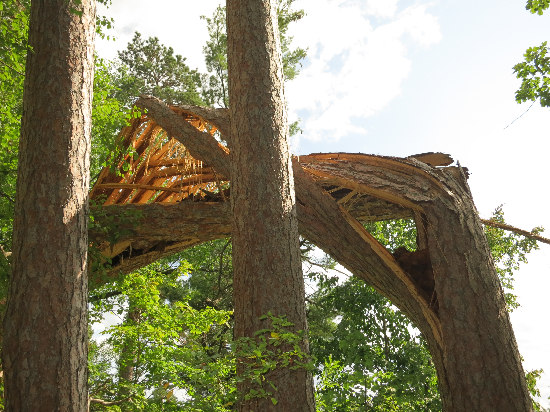
I cannot imagine the wind force needed to snap and twist a perfectly sound Red Pine of this size. It was nearly 18" DBH. Boo-hoo...
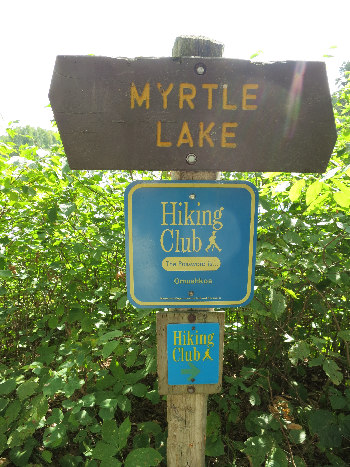
We have seen these " Hiking Club" signs throughout Minnesota. I finally got around to checking it out.
The best way to get to know the natural state of Minnesota is step by step. You can do that by becoming a member of Minnesota State Parks'Hiking Club.
The Hiking Club combines the best elements of an expedition, a classroom, and a treasure hunt. As a club member, you hike on selected trails which wind through Minnesota's most beautiful settings. Plus, you earn awards as you hike!
Earn a colorful patch after hiking 25, 50, 75, 100, 125, 175 and all miles. Hike 100 miles and you'll also receive a coupon for a free night* of camping. Complete all the miles and your rewards will include a free night* of camping plus an engraved plaque. All you have to do is hike the trails marked with a "Hiking Club" sign, enter the park password in your book (the password is posted at the midpoint of the trail), and you're on your way.
Source: Minnesota DNR
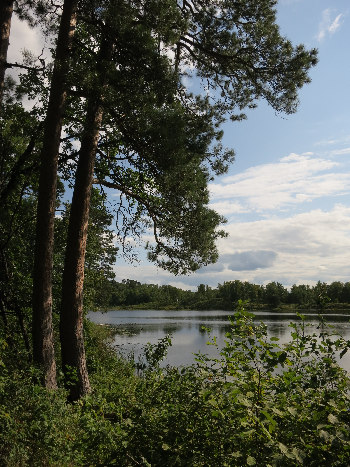
What an idyllic place to camp—on the shores of Myrtle Lake.
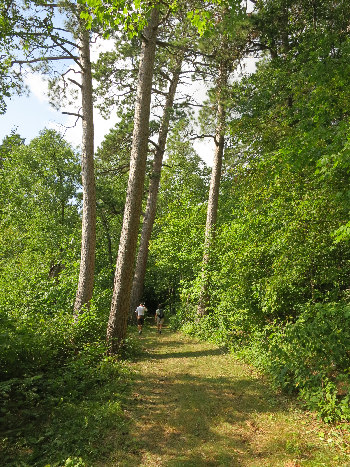
The Red Pine Trail finally opened back up, and near the intersection of Deer Park Trail, we were hiking through the big pines again.
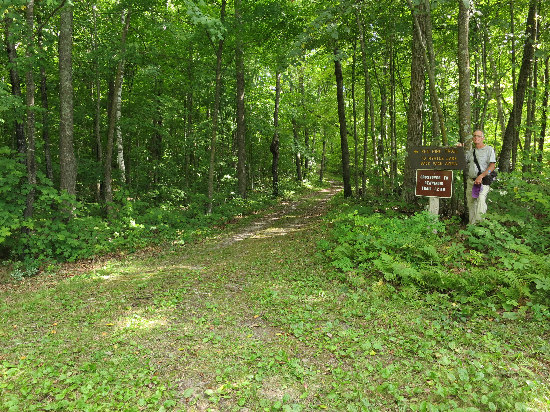
We got a bit confused at this intersection. Although it was well signed, its placement made our next turn a bit debatable.
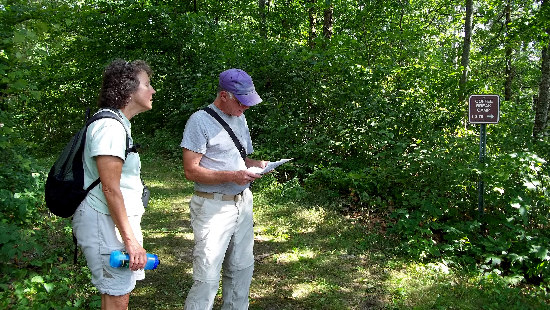
We always carry a trail map! Even with one I sometimes get "lost." So, you can imagine how we might end up without one.
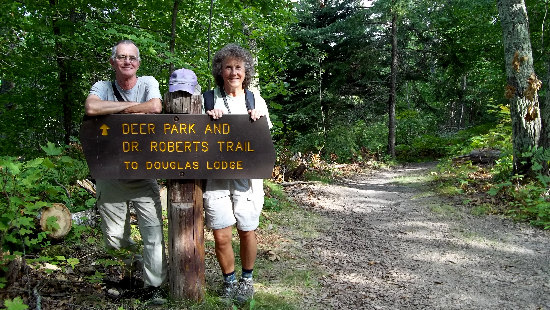
Roger took this shot and the preceding one. Nothing like having a human tripod with you. Thanks, Roger!
We were now near the end of the hike, and since it was getting close to supper time, we beat feet to the dining hall at Douglas Lodge.
Itasca's rustic—style design is the largest collection of log–constructed buildings in the state park system. It provides a uniform appearance to the park, setting it apart from all others. Douglas Lodge, built in 1905, is the oldest surviving building and the first to be constructed in the Rustic Style. [13] This structure is located along the south shore of Lake Itasca and was built using peeled logs harvested from the surrounding forests.
Funded by State legislature in 1903, it became the first building to house the park's visitors. Originally, it was called "Itasca Park Lodge" or "State House," but it was later named after Attorney General Wallace B. Douglas, a prominent figure in the battle to save the timber in Itasca State Park at the start of the 20th century.
At the time, very few governments were setting aside land for conservation, which shows the significance of this encounter. Douglas Lodge has provided tourist facilities since 1911 and remains functional today after undergoing renovations in the years following its grand opening. The Lodge is used as a hotel for guests to stay in and the main lobby for the "Douglas Lodge Cabins" around it. There is also a restaurant famous for wild rice soup.
Source: WikiPedia
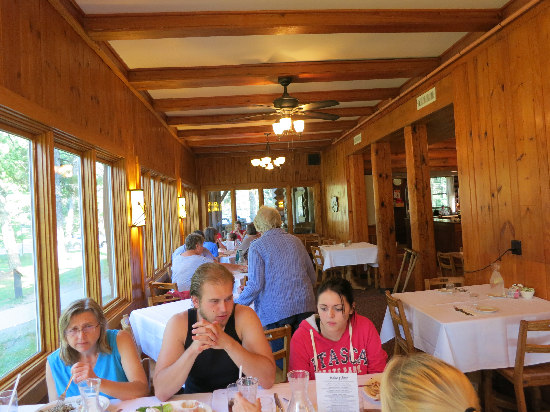
While we waited for our orders to be filled, I grabbed a few shots of the interior of the dining room. All those windows must make it tough to heat during the cold Minnesota winters.
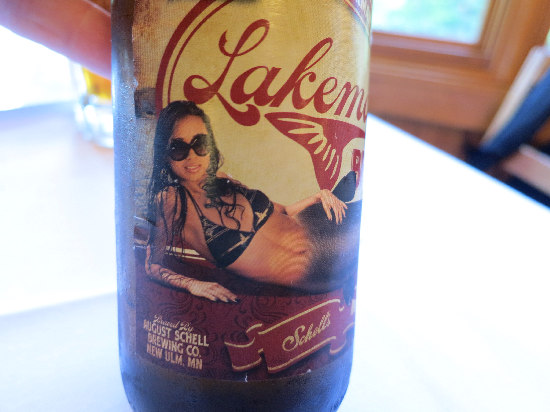
Roger's beer was ornamented with a Mermaid. He liked it.
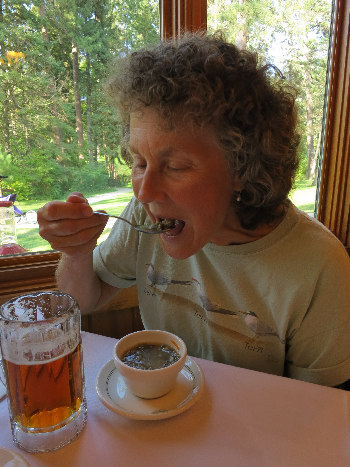
Betsy enjoyed the Wild Rice soup which the Lodge is famous for.
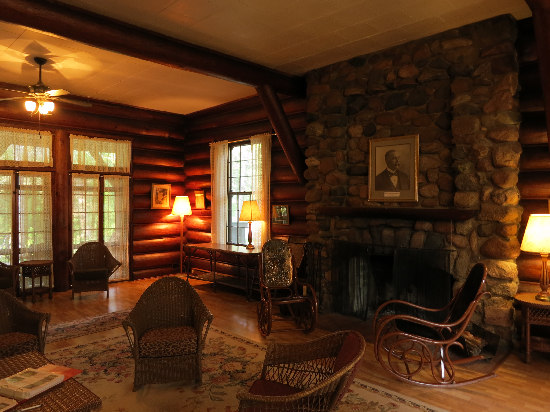
After supper we explored the lodge and ended up in the sitting room. What a nice place to curl up with a book and have a nice glass of red wine.
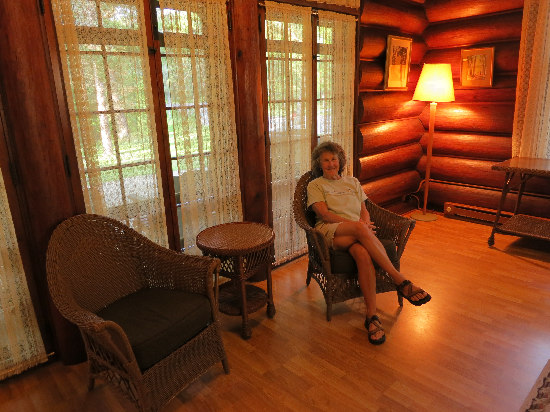
Betsy tried out these old wicker chairs. I am sure she would have loved to stay put for a few days!
Tuesday, August 14th: Return to Itasca
The next day Roger decided it would be simpler to ride in the back of the van than take his car or motorcycle. The back of the van has no seats and thus no seat belts. Since Roger rides a motorcycle and is used to living dangerously, this did not bother him.
We were fortunate to have yet another warm, breezy, and sunny afternoon. Perfect for getting out, not just for us but for lots of other folks as well.
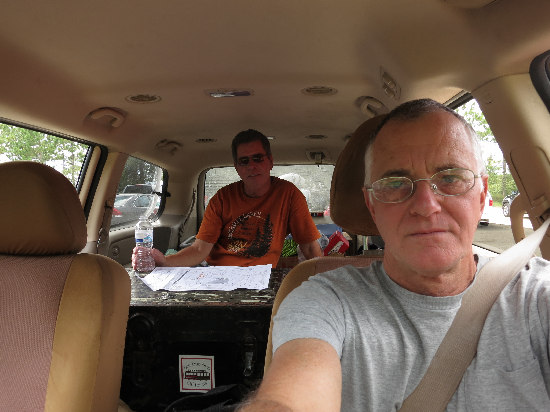
Roger used my old footlocker for a map—reading desk while I drove us back over to Itasca State Park.
There is lots to see at Itasca State Park, both on foot and by car. Since my wounded leg was in need of some downtime, we decided to take the Wilderness Drive, which is a 10-mile, one-way route that starts at the Lodge and ends at the Mississippi River Headwaters Center. There are a number of pull-outs along the drive with various points of interest.
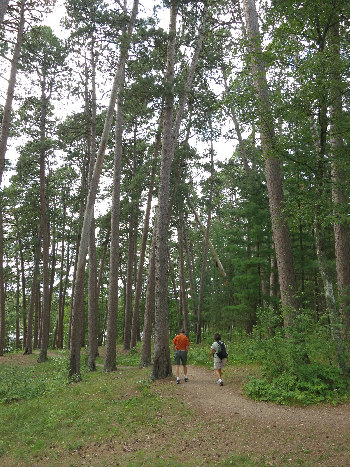
Our first stop was "Preachers Grove," so called because it was, once upon a time, the meeting place for a religious group. There are many stately Red Pines here and I can see why someone who was seeking a spiritual experience might come here.
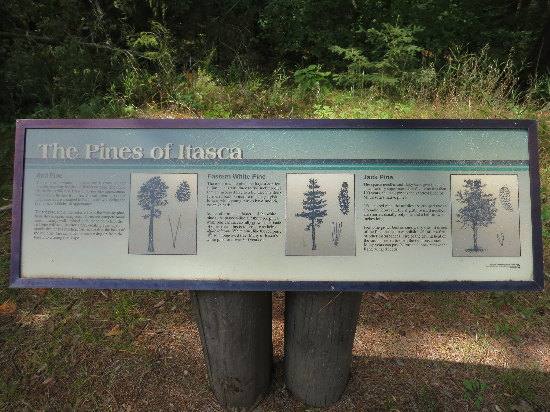
This sign told about the three pines in Itasca - Red, White and Jack.
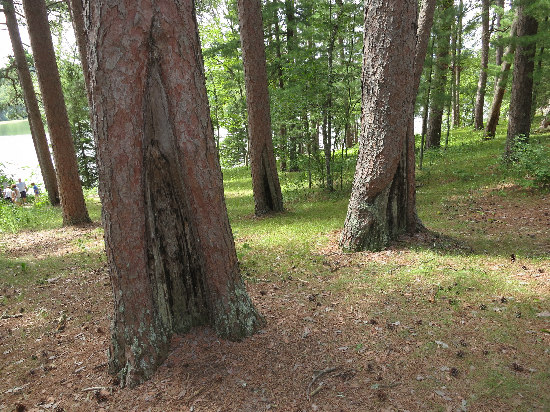
Like many pines, Red Pine has fire—resistant bark. The scars on the base of these trees are from past fires.
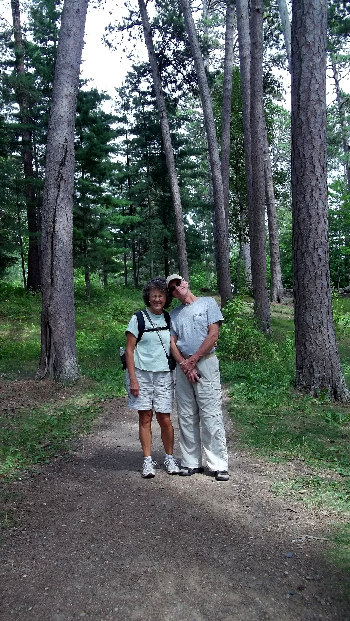
Roger took this photo of Betsy and me acting goofy.
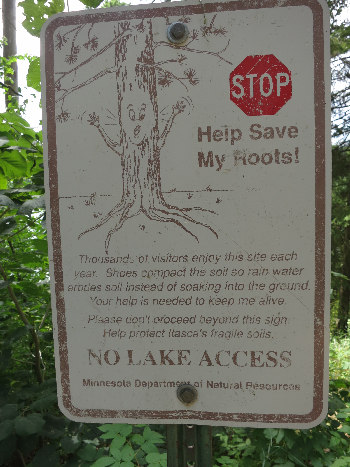
The trail went down to the banks of Lake Itasca, where this sign was posted. Itasca sees a lot of footprints!
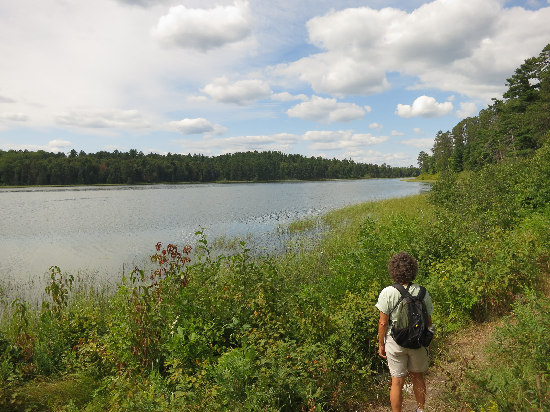
Here, Betsy looks north up the east arm of Lake Itasca.
Lake Itasca is a small glacial lake, approximately 1.8 square miles (4.7 km2) in area, in the Headwaters area of north central Minnesota. The lake is located in southeastern Clearwater County within Itasca State Park, and it has an average depth of 20–35 feet (6–11 m), and is 1,475 ft (450 m) above sea level.
The Ojibwe name for "Lake Itasca" was Omashkoozo-zaaga'igan (Elk Lake); this was changed by Henry Schoolcraft to "Itasca"[4], coined from a combination of the Latin words veritas ("truth") and caput ("head"). It is one of several examples of pseudo-Indian place names created by Schoolcraft.
Source: WikiPedia
![[4]](http://www.pgdp.net/c/tools/project_manager/displayimage.php?project=projectID45d7c990c6295&imagefile=243.png&showreturnlink=1&preload=prev&percent=100&jumpto=244.png)
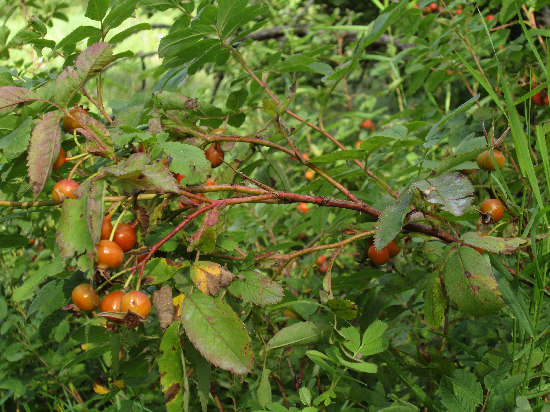
Betsy took this photo. It shows the hips, or fruits, of the Prickly Wild Rose (Rosa acicularis). At least, that's what I think it is.
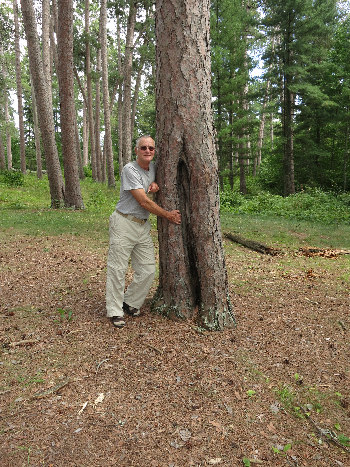
This will give you some idea of the size of the Red Pine and the fire scar.
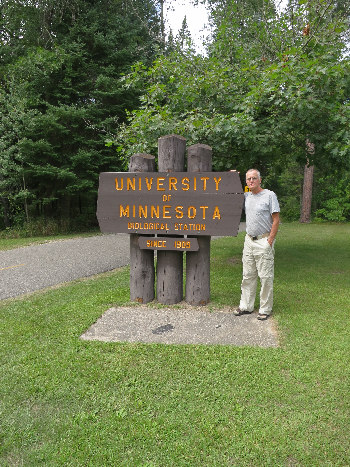
It has been 35 years or so since I stood at this site. My, how time flies...
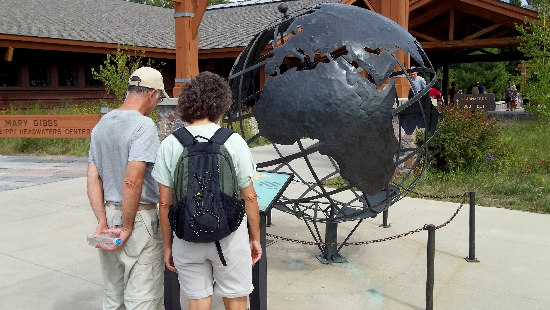
This display is at the Mary Gibbs Mississippi Headwaters Center. It shows a map of the world with all the longest rivers highlighted. The Mighty Miss ranks 4th behind the Yangtze, Amazon and Nile.
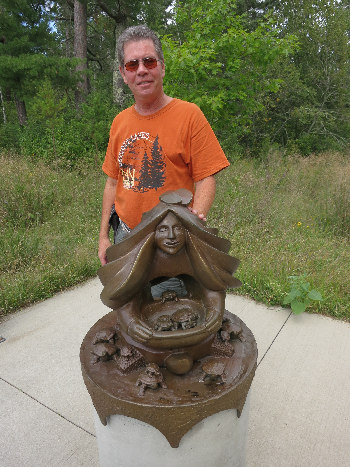
This metal sculpture is along the trail to the Headwaters. It is entitled "Heartwaters—Caretaker Woman". The artist is Jeff Savage, who is a member of the Fond du Lac Band of Lake Superior Chippewa.
The artist has this to say about his inspiration for the sculpture:
When looking at the headwaters site, the vision I see is of a woman standing with cupped hands around a bowl (Lake Itasca) with the life force of the headwaters spilling out of the bowl and the Anishinabe symbol of natural life, the turtle, standing watch over these headwaters. ~ Jeff Savage
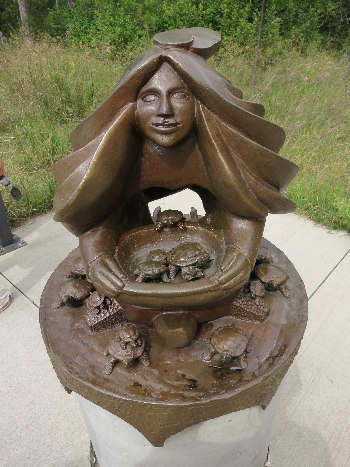
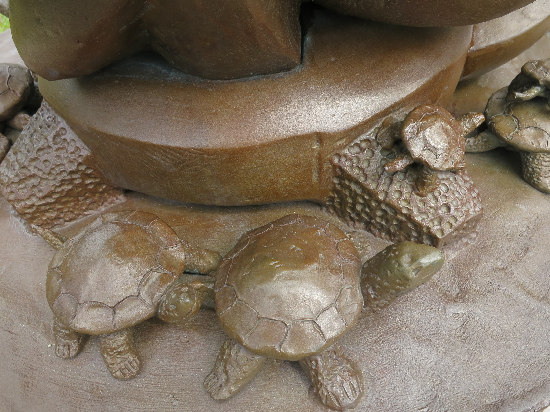
The turtle is a sacred figure in Native American symbolism as it represents Mother Earth. The meaning of the Turtle symbol signifies good health and long life. The turtle has great longevity living up to 150 years. According to Native American legends and myths of the Eastern Woodland tribes the turtle played a part in their Creation myth.
The Earth Diver turtle swam to the bottom of the water that stretched across the world. He surfaced with the mud which the creator used to make the earth. The hard shell of the turtle represents perseverance and protection. For additional information refer to Power Animals. The shell of the turtle is used to dispense medicines because of the association with Spiritual Healing properties and the shell is also used to make dance rattles. The symbol of the turtle in Southwest tribes such as the Hopi and Navajo represents water - a much sought after commodity in desert regions.
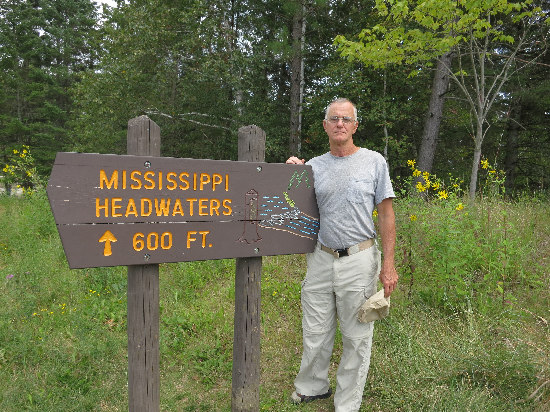
As Roger mentioned to me, some dispute Lake Itasca as being the source of the Mississippi River. And, if you look at a map you can see where White Earth Lake might look like the source. But, no matter. With most - perception is reality.
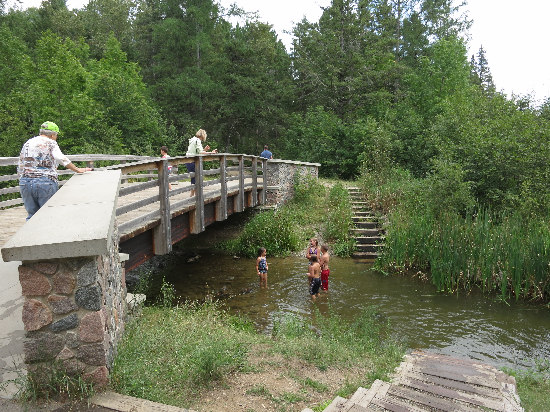
These kids playing in the water were a preview of things to come.
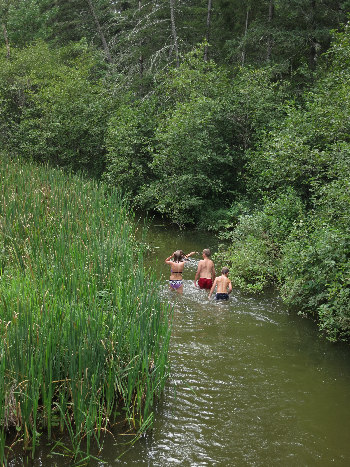
They soon disappeared, giggling and splashing, into the cat-tales and alder.
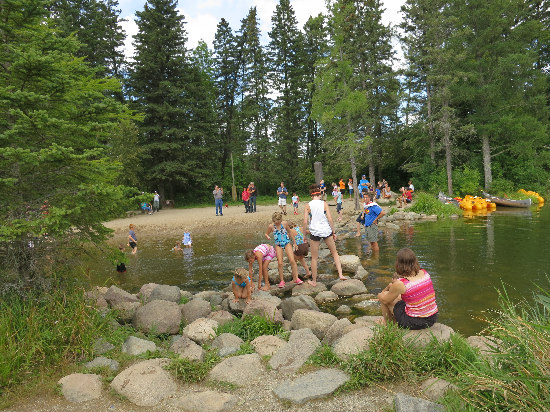
And here is where they were going - the little stream which is the beginning of the Mississippi River.
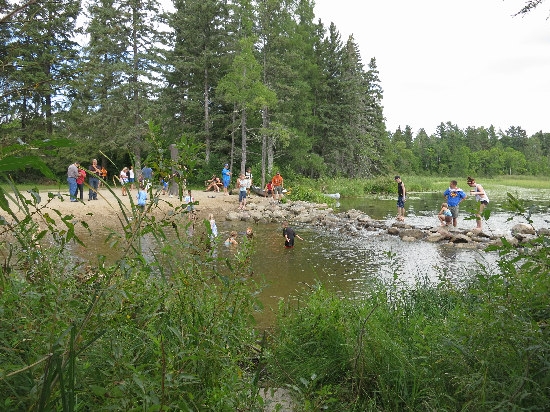
There was a carnival like atmosphere what with all the people talking, laughing, splashing in the water while others looked on.
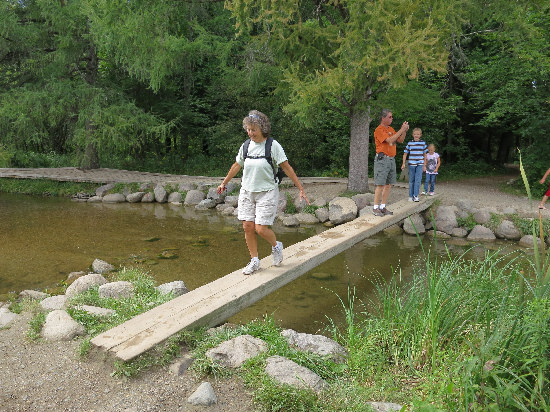
Betsy does not like "heights" but she dared to cross the Mighty Miss anyway.
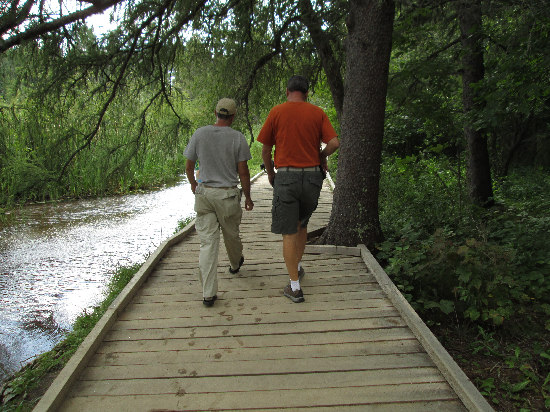
Betsy took this picture of Roger and me. She requested it be included 'cause she thought it was cute. Girls!
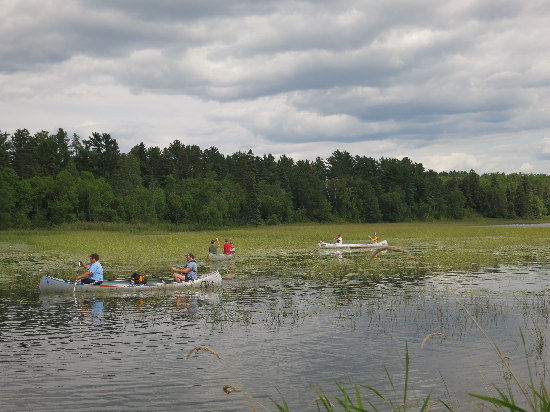
These are just a few of the canoes and kayaks which were milling around the headwaters area of the lake.
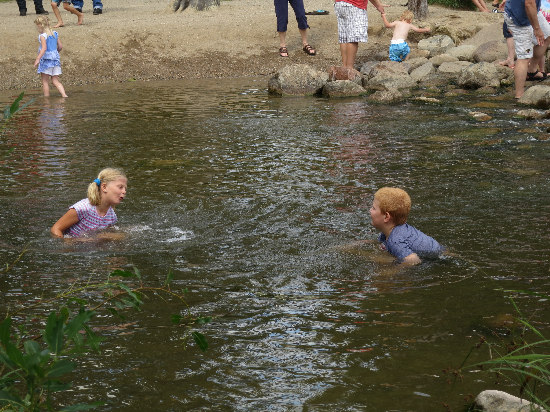
All the kids were having a blast.
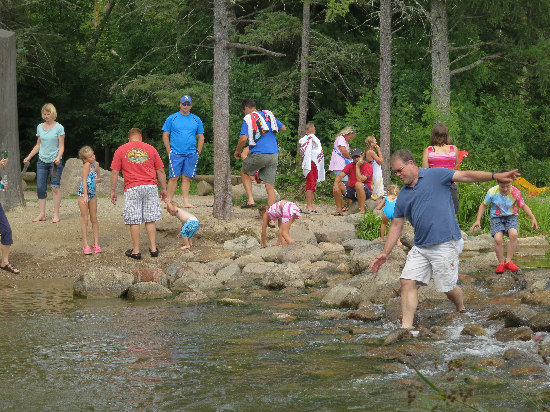
Some of the adults were not. There was a sign warning about the slippery rocks and this guy found out first hand (or foot) they weren't kidding.
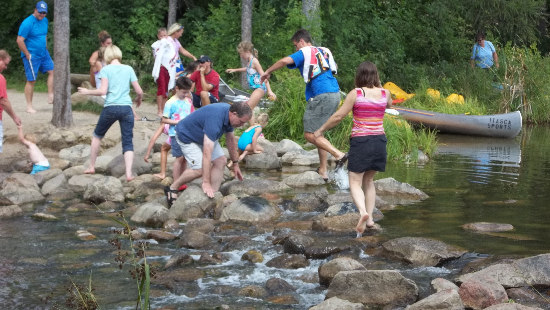
Roger got this shot as the guy almost went down. As you can see he had a lot of company.
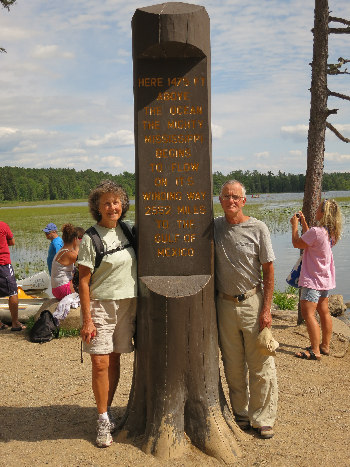
Roger took this shot for us to commemorate out visit.
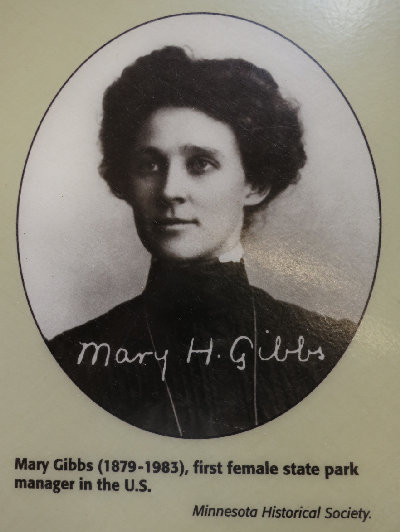
I would like to have met Mary. What a pistol!
Mary, who lived to be 104 years of age, spent her last years in a nursing home. At the age of 102 she went on a hunger strike when she was told she would have to pay an extra 75 cents to have meals served in her room.
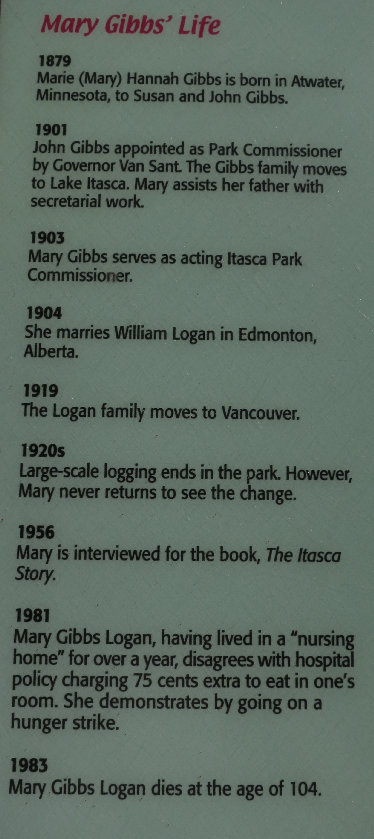
On April 20, 1891, Minnesota governor William R. Merriam signed into law a bill creating Itasca State Park—the first piece of Minnesota land to be designated a state park. But, as historian Roy Meyer writes, "as was to be the case many times in later years, the legislature's passage of an act authorizing a park did not mean that a park existed." The state of Minnesota owned only a small portion of the parkland described in the legislation. The rest, including the headwaters of the 2,552-mile-long Mississippi River, was owned by the federal government, by railroads, and by logging companies.
And so over the next decades a struggle ensued to acquire the land that would eventually become one of Minnesota's most popular destinations. The federal lands were turned over with little fanfare, and eventually the state legislature appropriated funds to begin purchasing some of the land from private companies. Meanwhile, though, Itasca's valuable resources—notably its trees—continued to be harvested. One particularly notorious moment in the struggle between conservationists and loggers occurred in 1900, when loggers dammed the Mississippi and flooded Lake Itasca, which they filled with cut timber. This went on for three years until Mary Gibbs, a young woman who had taken over as state park commissioner after her father's death, served a warrant to loggers—-despite death threats—-that forced open the dam gates and relieved flooding on the lake.
Large-scale logging finally ended in Itasca State Park in 1920. In the 1930s, with the help of the Civilian Conservation Corps, the park was spruced up—trees were planted, a dam was built to stabilize the lake level, and the log buildings and lodges still in use today were built. Today the park totals more than 32,000 acres with more than 100 lakes, including Lake Itasca, which draws close to a half million visitors a year.
Source: Minnesota Historical Society
After saying good-bye to Mary, we continued on our trip around the Wilderness Drive
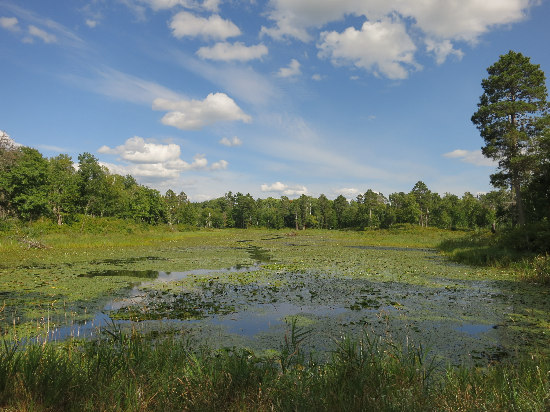
We passed this lovely "lily pond" on the way to see The Big White Pine.
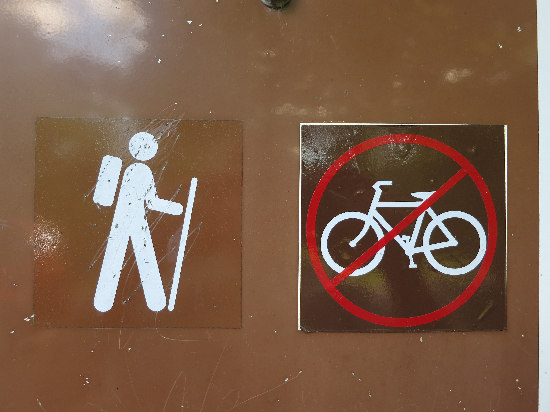
This is one of my favorite trail signs. Problem is, most mountain bikers would ignore it. You see, most mountain bikers think they are special and should be allowed to ride anywhere they choose.
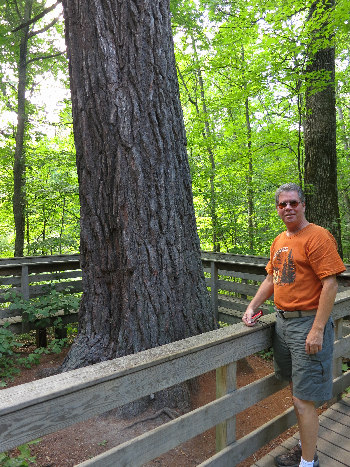
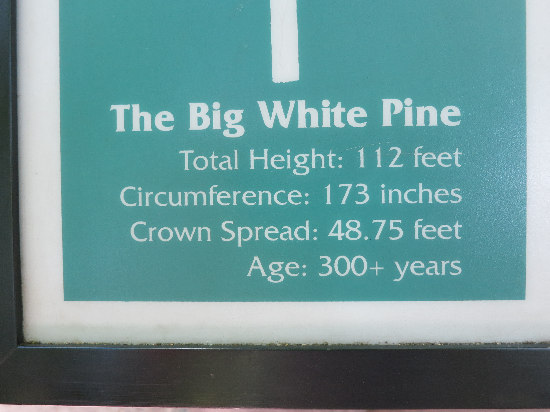
Here it is! Over 300 years old and 112 feet in height.
In 1837 there were 3,500,000 acres of virgin White Pine in Minnesota. Currently about 2% of that remains - a paltry 67,000 acres. Not very good resource management.
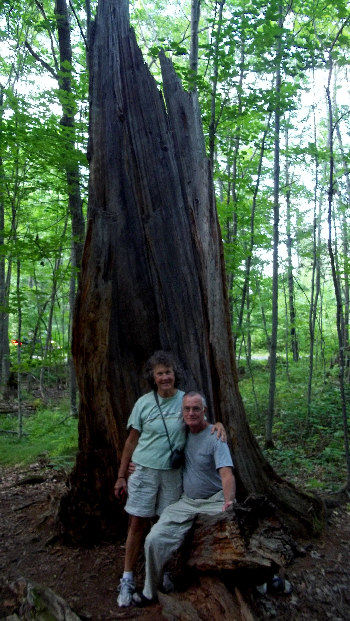
On our way back from the Big White Pine, we passed this vestige of yet another behemoth.
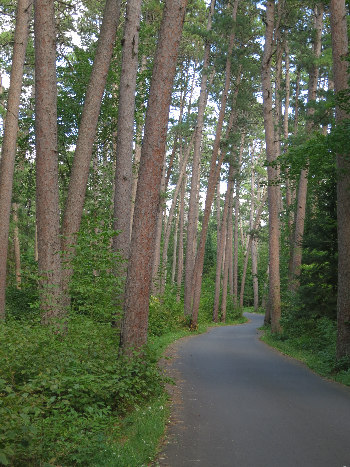
This is along the one-way portion of the Wilderness Drive. What a place!
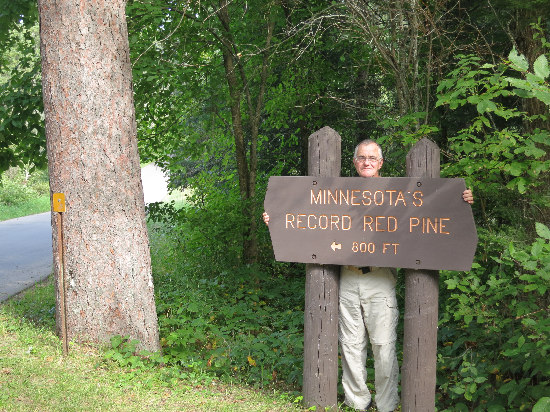
Now, on to the Big Red Pine.
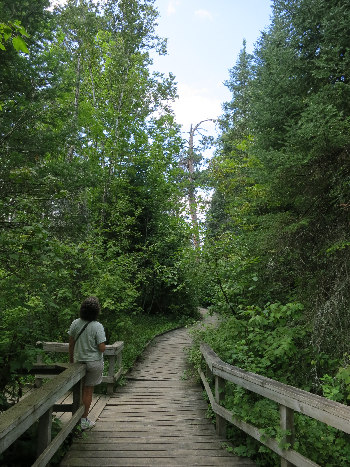
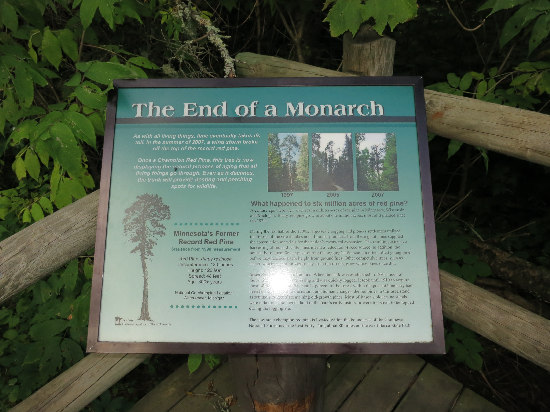
Unfortunately, this Ancient One had the top snapped off by high winds in 2007.
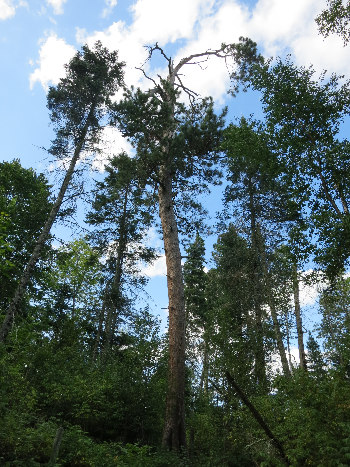
When a conifer loses this much of its crown it means the end is near.
Red Pine usually grows at the rate of 12" per year. And since all the old ones were cut decades ago, that might explain why so few of the big trees remain.
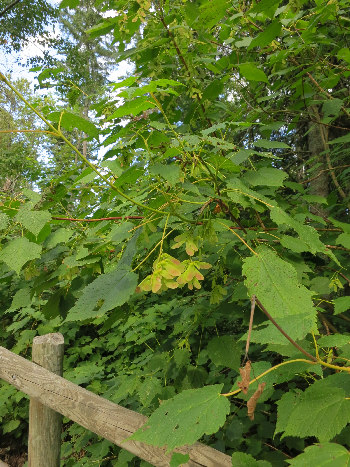
On the way back to the car from the Big Red Pine I noticed a nice specimen of Mountain Maple (Acer spicatum). We have Mountain Maple in West Virginia where it grows primarily in the highest elevations of the state where it is cooler. In the spring it has upright "spikes" of white flowers. Thus, the specific epithet "spicatum"
Acer spicatum (mountain maple) is a species of maple native to northeastern North America from Saskatchewan to Newfoundland, and south to Pennsylvania. It also grows at high elevations in the southern Appalachian Mountains to northern Georgia.
The tree lives in moist woods in rich, well-drained soils on rocky hillsides and along streams. It also grows on ravines, cliff faces, and forested bogs. During ecological succession, it colonizes the understory as pioneer species die.
Source: WikiPedia
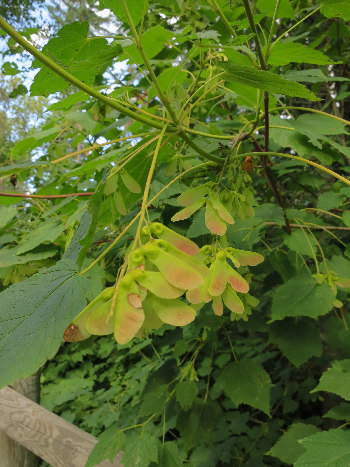
A closer look at the wing fruits, also known as "samaras". As the seed falls, the "wings" cause it to spin.
A samara is sometimes called a key and is often referred to as a whirlybird, helicopter, whirligig, polynose, or, in the north of England, a spinning jenny. During the autumn months, they are a popular source of amusement for children who enjoy tossing them in the air and watching them spin to the ground. ~ WikiPedia
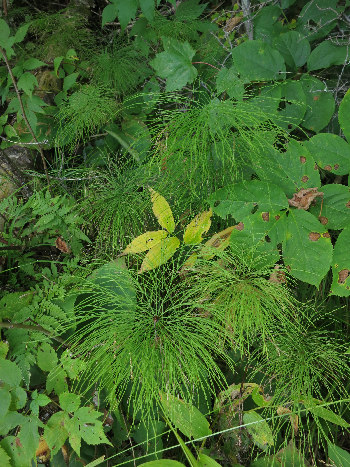
Here is a plant we have seen many places in Minnesota, and it is particularly abundant in Itasca State Park. It is the Wood Horsetail (Equisetum sylvaticum). It is one of the so—called "fern allies." It is a non-flowering vascular plant that reproduces from spores like the "true" ferns.
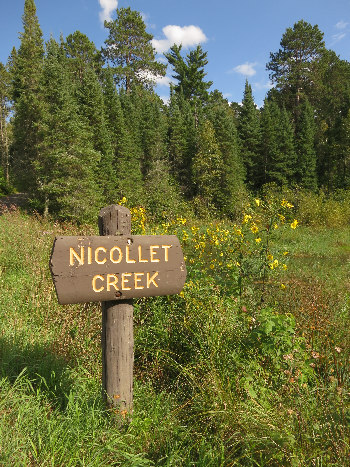
Just past the turnoff for the Big Red Pine is lovely Nicollet Creek.
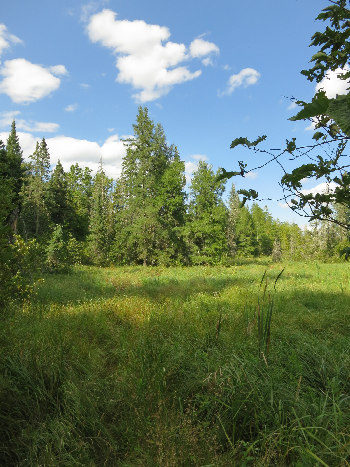
Most of the creeks and smaller rivers up this way have wet meadows, bogs, or swamps associated with them.
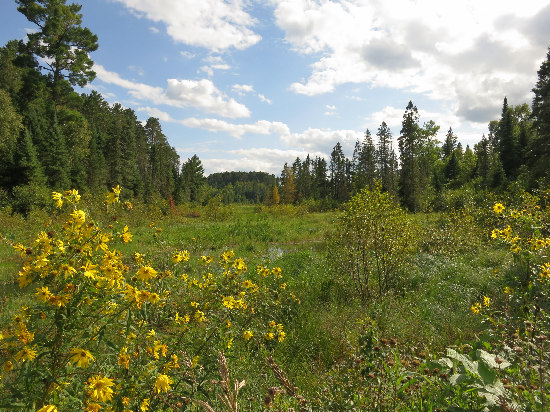
What a lovely spot.
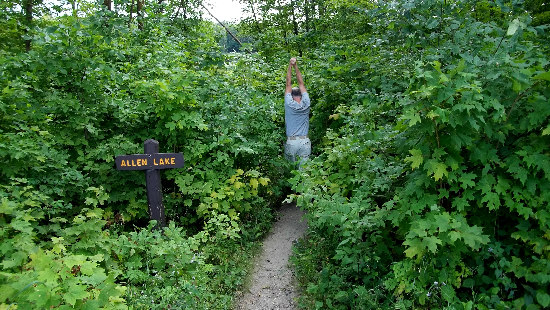
Next we went to the observation tower. But first I had to attend to a sudden call of nature and chose, for some reason, to duck in here.
I would guess the lake was named for Lt. James A. Allen, who, along with H. B. Schoolcraft, explored and mapped much of this area.
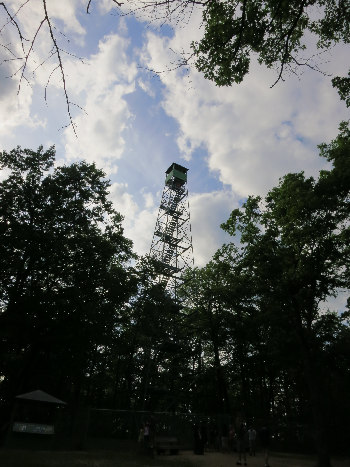
Here is all we saw of the 100' tall Aiton Heights Forest Fire Tower. The park was busy that day, and there was a crowd of kids waiting to climb the tower stairs. The tower has a limit of 6 at a time. Being impatient by nature, I was not interested in waiting. Roger tried to change my mind but was unsuccessful.
After that we left the park and headed back to Roger's, where he cooked us a nice dinner of grilled chicken, sweet corn, and salad. Roger—the Ultimate Host!


Web page Comments or Questions? Contact Mike Breiding
Featured Posts
⋄ San Francisco ⋄
⋄ Winter Birding in Southeast Arizona ⋄
⋄⋄⋄⋄⋄⋄⋄⋄
Epic Road Trips
Master Index
2025
- November
A Postman's Holiday
My Starr Valley Hike with Cyd - October
Madera Canyon Walk - Road Trip to Tucson
- September
An Unexpected, but Welcome Guest - August
McTrail Rail-Trail:
Butterflies, Caterpillars, and Ferns - June-July
A Week In The Heart of The Highlands of West Virginia - April-May
Farewell to April and May - May
The Betsy Update
A Springtime Walk on the Rail-Trail - March
Hiking the Mt Lemmon Loop with 3Sixty Bruce - A Mountain Lion sighting in Tucson Estates
- Why Is This Woman Smiling?
- February
Betsy Tours the Baja Peninsula - January
The Shiva Saguaro of the Avra Valley - Sabino Canyon: Up and Down
- Sabino Canyon: Phone Line Trail to the Big Rock
2024
- December
Oak Tree Canyon - Arizona Trail - Christmas Day Hike to
Wasson Peak in the Tucson Mountains - November
Hiking the Sweetwater Preserve - Thanksgiving Day
Hike to Rogers Rock - October
Morgantown to Fort Wayne
Betsy's Greyhound Adventure - July
The Wilds of Pennsylvania - May
Our 42nd Wedding Anniversary Road Trip - Springtime Walkabout in Oglebay Park
- Springtime in the West Virginia Mountains:
Hiking the Scott Run Loop in
Coopers Rock State Forest - March
Tucson to Morgantown:
El Paso, Marfa, Alpine, Georgia,
San Antonio, Sleepy Hollow,
Berlin Homestead and Cabin #18 - AZ: Catalina Mountains
Hiking up Pima Canyon to the First Dam - February
Ecuador Birding with Betsy in the Ecuadorian Andes - January
AZ: Tortolita Mountains
Alamo Springs and Wild Mustang Trails Hike - Winter Birding in Southeast Arizona
- August
Colorado - Six Days of Hiking:
Rocky Mountain National Park Area - December
Christmas with Mike and Betsy - 1982 to 2022 - September - October
* Introduction: California and Oregon Road Trip
* California - Beautiful Basin and Range, Tehachapi Loop, and Cesar Chavez
* California - Out of the Central Valley and Visiting Our Favorite Aussie
* California - San Francisco ~ Day 1 Part 1
* California - San Francisco ~ Day 1 Part 2 - August
Chautauqua Creek Gorge - May
Our 40th Anniversary Celebration
Longwood Gardens
Jenkins Gardens
Betsy's Photos
- March
Tucson to Morgantown Part 1
Tucson to Morgantown Part 2 -
End of Season Potpourri
Cacti, Wrens, Pots and Pies - February
Hiking the Painted Hills in Tucson Mountain Park
A Rainy Morning Turns into a Fine Day - January
Golder Ranch Hikes
in the Catalina Mountains -
Our Hike to Seven Falls in
Bear Canyon - December
Hiking the Desperado Loop:
Sweetwater Preserve - November
Happy Thanksgiving! -
Starr Valley Sampler
Tucson Mountain Park - Sonoran Sunset
- October
Morgantown to Tucson - September
Clarence Beal Remembers Roger Tory Peterson
A Tale of Beals, Breidings, Birds and Love - August
Betsy Kayaks the Lower Columbia River - July
Four Days Hiking the Highlands of West Virginia - A Summer Time Walk in Oglebay Park
- June
How We Met the Frog Maiden - May
A Rainy Walk in Oglebay Park - April
Wrapping up our 10th Winter in Tucson
and a return to Almost Heaven and Spring Time Walks on the Mon River Rail-Trail - Quick Takes: Winter of 2020 - 2021
- An index Page for all of 2020 is here
- October
Tucson Winter: 2020 - 2021
Hiking and Biking and More - Our 10th Year in Tucson:
Getting off to a Good Start - Morgantown to Tucson:
Back Roads and Some New Territory - Deckers Creek Rail-Trail
Masontown to the End of the Trail: Summer's End - A Comparison of Concrete and Wooden Bridge Decking of Rail-Trail Trestles: 1999 to 2020
- August
Along Came a Spider:
A Kayakers Tale of Woe by Betsy Breiding - May
Your Order Has Arrived!!!:
A Covid poem by G Sutton Breiding - March
Tucson to Morgantown
Mr Corona Chases Us Home - Sonoran Wildflowers
Catalina State Park - Tucson Area Hikes
Potpourri - February
Tucson Area Hikes: Potpourri Number 1 - December
Catalina Mountains
Sabino Canyon Wander - Christmas in the Rincons
-
Santa Rita Mountains
Hike to Rogers Rock - November
The Roof of the Rincons:
Hiking the Tanque Verde Ridge Trail
to Grossman Dome -
Perch Party at Bob's in Tucson Estates
A Lofty Time - October
Gordon Hirabayashi - History - Catalina Mountains:
Prison Camp to Sycamore Canyon Hike - The Tucson Mountains:
The Bowen House - 87 Year Stone Ruin - YIPPEE! Back in the Sonoran Desert
- Summer Update:
The Vacation That Wasn't - April
Sabino Canyon Wildflowers - March
Sonoran Desert Wildflowers: Two Hikes
Sutherland Trail in the Catalina Mountains
King Canyon in the Tucson Mountains - January
New Years Day Hike to the Summit of Wasson Peak in the Tucson Mountains - 2018 - The Year in Review
What Mike and Betsy Did - November
Birds and Bats and Lizards - Oh My!! Fun with our Animal Freinds - October
California Road Trip - Saying Good-bye to Mom - Krein Summit Hike in the Tucson Mountains
- The Santa Rita Mountains: Madera Canyon Nature Trail
- April
Tucson to Wheeling: April 2018 - February
Las Vegas and the Red Rocks - August
10 Days in Wyoming, Utah and Colorado - July
Flood Damage at our Wheeling Home - Two Weeks in Michigan
- June
Betsy's Ireland Adventure - May
Our 35th Wedding Anniversary Celebration: Road Trip! - April
Tucson to Wheeling:
Wrapping Up Our Sixth Winter in the Tucson Mountains - December 14th
64 & Counting: Getting High on My Birthday - September-October
Road Trip: Wheeling to Tucson - July
Michigan Road Trip - May & June
Road Trip: Northwest Pennsylvania and Western New York - May: Arizona
The Wrap Up - Our 5th Winter in Tucson - March: Arizona
My First Glider Flight at the Tucson Soaring Club Gliderport - January: Arizona
South and Central Arizona Road Trip - Wheeling to Tucson
September the 30th: Getting Off to a Rough Start - March: Arizona
Winter Number Four in SE Arizona - March: Texas
Texas Wildlife: Dead and Alive - March: Arizona
Foray to Fred's Arena, Bar & Steakhouse - May: West Virginia
Mike and Betsy Do 33 Years of Hard Time - May: Michigan
Michigan Meander: From the Thumb to the Yooper - July: Pennsylvania
Pennsylvania Road Trip - July: West Virginia
Betsy tries out Stand Up Paddle Boarding - September: New Brunswick
New Brunswick - Exploring the Fundy Trail - December: Arizona
Hats Worn by a Hillbilly - January:
South East Arizona - Tucson Mountains: Hiking the David Yetman Trail - Jan-Feb-Mar: Arizona
Our Third Winter in SE AZ - April: Utah
Return to Honeymoon Heaven - June: West Virginia
Field Trip to the Central Appalachian Mountains of West Virginia - July:
Solo Sojourn: Illinois - Wisconsin - Michigan - September:
San Francisco Road Trip
Damnation Creek Hike at Del Norte Coast Redwoods State Park - September:
Fun with Betsy in San Francisco - November:
Movin' On ... After 27 Years - The End of an Era - November: Southwest Florida
In Search of Warmer Temperatures - October: San Bernardino Mts
of Southern California:
Intro - September: Michigan and Wisconsin Road Trip
Intro - June: Our First New England
Road Trip
Intro - May: Walking the Scottish Highlands
Intro and Itinerary - May: Madrid and Segovia
Intro - Snowbirding in Arizona
Intro - Great Smoky Mountains NP
- 3 Weeks in Minnesota
- Ohiopyle State Park
- Escape From Morgantown
- Martin and Kathy: The Wedding
- From 30 to 62: Senior Citizenry
- Mike and Betsy's Big 30
- ASS Bicycle Ride
- Green Valley or Bust!
- Road Trip to San Francisco!
- The Flight of the Snow Birds!
- WV: Greenbrier River Rail-Trail
November:
Green Valley or Bust!
Morgantown WV to Belzoni MS- Spain - 10 Days in Segovia
- San Francisco!
- Martin's 50th Birthday Bash
- Alaska
- Betsy's Retirement Party
- Three Weeks in Michigan
- 3 Weeks in Michigan:
Betsy's Journal - Dunkard Creek Float Trip
- Central and
Southeastern States - Three weeks in San Francisco
- Four Weeks in Texas
- Another Tree Mutilation in Morgantown
- Tygart Lake SP: WV
- Martin's Birthday Bash
- Raleigh, NC
- Mexico
- Texas
- The Grounds of Hornbeck
- Mason-Dixon Park Hike - PA&WV
- BBC at TA - WV
- Dolly Sods Reunion - WV
- Christmas in Fort Wayne
- Coopers Rock State Forest, WV
- Terra Alta Spring Reunion, WV
- Morgantown Bike Parade
- Our 25th Wedding Anniversary
- Happy Hour at Paul's
- 4th of July Cookout
- Central California
- MD and WV Mountains
- Beal Reunion - NY
- Double Nickel Sushi
- McTrail Rail-Trail - WV
- Coopers Rock State Forest - WV
- White Park Winter - WV
- Terra Alta in Winter
- Oklawaha Visitors Center Trail
- Otters and Cranes
- Cocoa Beach Sunrise
- Viera Wetlands
- Florida
- Southern New Jersey
- Big Savage Tunnel, PA
- Mon River Float Trip, WV
- Allegheny Highlands Rail-Trail
- Coopers Rock State Forest, WV
- Youghiogheny River Float Trip
- Terra Alta Work Weekend, WV
- Mountaineer Triathalon, WV
- Pennsylvania and New York
- Terra Alta Celebration
- CRC Sturgisson Picnic
- Our Second Car Crash
- Betsy's Rehab
- Dan's 50th Birthday Bash
- DiBartolomeo's 4th of July Party
- Hostas at Hornbeck
- Kathy's Big 50!
- Maiden Voyage
of the Monongahela Monitor - Monongahela River Views
- My First Solo ERT
- Illinois and Wisconsin
- The New MCTRAIL Rail-Trail
- Allegheny Highlands Rail-Trail
- Digging, Dividing and Planting Hosta
- Joe's Run Loop - WV
- Labor Day Cookout
- Jeffrey A. Mann Reception
- MRTC Poker Run
- Cycling Over Mt Davis - PA
- Potomac Highlands Cycling Tour
- Beal Reunion - Indiana
- Pedestrian and Cycling
Tunnels,Bridges,Overpasses - Il&WI - Seneca State Forest - WV
- Thanksgiveing Snow - NY
- Yough River Rail-Trail
- Happy Hour at the Brew Pub
- CRC Christmas Party
- The Jimmy Thibodeaux Band at The Crazy Corner
- McTrail Rail-Trail WV
- ~ A Really Beally Christmas ~
- Dunkard Creek Float Trip - WV
- Florida or Bust!
- Body Art
- Country Roads Cyclists
- Lost Creek Rail-Trail Dedication
- Mon River Rail-Trail Drainage
- Potomac River Float Trip
- CRC Pizza Party
- Susan's Big 50th
- Jamestown - New York
- New Orleans
- Typical Male Brain
- WV: Paddling The North Branch Of The Blackwater River
- WV: West Fork Rail-Trail
- Ohio and Erie Canal Towpath Trail
- Niagra Falls
- Cycling the New York Canals
- San Francisco: Visiting Brother Bill
- Lindy Point - WV
- Wisconsin Rail-Trails and More
- Michigan and Ohio: Hiking and Biking
- The Big Trip - 13 States and 5000 miles
- Christmas Vacation in Southern Arizona
Hiking and Biking
in the Sonoran Destert - West Coast Trip
(Exploring San Francisco, Central California, Northwest Washington and the Coast of Oregon) - Report From Fort Wayne:
Flatland Cycling, Beal History
and an Indiana Thanksgiving - San Francisco: Visiting Brother Bill
- Bawdy Fern Humor
- Mike and Betsy's Honeymoon
- San Francisco: Family Photos
- The Original Epic Road Trip
- Julian Weldon Martin: Commentary
- G. Sutton Breiding: Poetry and Prose
- Craig Mains: Travelogues
- The Saguaro Forest
April 1937 National Geographic Magazine - Photo Sampler 1
- Beal Family Scans
- George H. Breiding
- Mom - Jane Rector Donaldson
- Wayne Paul Breiding
- Elizabeth Ann Bartholomew
- Joe Gatski
- Ashok Bhatnagar
2023
2022
2021
2020
2019
2018
2017
2016
2015
2014
2013
2012
2011
2010
2009
2008
2007
FLORIDA
2006
2005
2004
2003
2002
2001
1999
1998
1997
1996
1995
1983
1982
1979
1966
The Works of Others
Misc
In Memoriam