Mike Breiding's Epic Road Trips: 2026
Veterans Day
by Curt Phillips
Here is the latest offering in "The Works of Others" category of ERT.
I thought an explanation was in order as to how I had the opportunity to read "Veterans Day" by Curt Phillips.
My brother Yinks (aka William, Bill) recently sent me an anthology of previously published articles from various 'zines. The anthology titled "The Essayist," Number 1 - August 2026, arrived in Tucson on October the 29th.
The publication, edited by Brother Bill and two others contained 3 introductions and 10 essays. I read them all; no mean feat for short attention span me.
When I read "Veterans Day" by Curt Phillips I was quite moved by it and I am not embarrassed to say I got a bit misty. ~mb
~~~~~~~~~~~~~~~~~~
Veterans Day
by Curt Phillips
HERE IN THE UNITED STATES we will very shortly be commemorating Veterans Day on November 11th; the anniversary of the end of the First World War. Originally called "Armistice Day" the name was changed many years ago to encompass the veterans of all wars — since it eventually became clear that the "War to End All War" — as WWI was referred to at the time — wasn't going to live up to its billing. And so each Nov. 11 — or sometimes the closest Saturday morning — many towns and cities all across America hold parades and other events to celebrate the veterans who've served in the military and to remember those who died in our wars.
Every kid loves a parade, and when I was very young my dad — a Korean War veteran of the us Air Force — used to take me to Bristol for the annual parade. This was back during the Vietnam War and I suppose that there was more open support for the military in those years than there would be just a few years later, but then my part of the country is very conservative and has a long tradition of supporting our people in the armed services, regardless of where they stood on the war at hand.
Those parades of my childhood were impressive affairs with whole companies of uniformed soldiers from the local reserve and National Guard units; tanks and military vehicles, high school marching bands, floats, and other attractions. Could you but look back in time to Veterans Day in Bristol in 1966, you might spot the 6-year-old Curt standing with his dad on State Street wearing his father's old Air Force dog tags around his neck and waving his small American flag as the local soldiers marched by.
The oldest veterans in our community would often ride in open convertibles or on the backs of flatbed trucks, and many of these were veterans of the First World War with signs that identified them as members of "The 30th Infantry Division," or even "Veterans of the Argonne" or of other WW1 battles.
One of my uncles always used to drive a car with my elderly great-uncle Luther Maynes in the parade. Uncle Luke was Bristol's last surviving Spanish-American War veteran and he became such a local institution that when he died a few weeks before Veterans Day in 1969, my uncle drove his empty car in the parade with signs edged in black crepe that read "In Memory of Pvt. Luther Maynes — Spanish-American War". Folks on the sidewalks stood and placed their hands over their hearts and soldiers saluted when my uncle's car drove by that day.
Americans of a certain age will remember the change in the spirit of our country in the early to mid 1970' as it slowly and very painfully became clear that the War in Vietnam had gone terribly wrong, and that the patriotic high we'd all been enjoying since WWII had contributed to leading us down a road that most of us realized far too late that we'd never wanted to travel. Apparently by 1974, folks around these parts didn't feel like holding parades much anymore, and Bristol stopped having the Veterans Day parade for the next several years. I was older by then and had other things to do anyway, and just didn't think about all that anymore. Time — instead of parades — marched by...
By 1989 I was married and was working as an electronic tech at a local company. The mood of America had gradually changed again and Bristol woke from its patriotic slumber and decided to start holding a parade on Veterans Day again. Out of, perhaps, a feeling of nostalgia I attended and saw something I'd never expected to see; a whole company of Confederate soldiers marching through Bristol. They were the first Civil War reenactors I'd ever seen and I followed them to the end of the parade, talked with a few of the fellows and made some contacts. A few months later I entered that hobby myself, as a Union soldier. (I'll tell you why I chose the blue over the gray someday in another article...). A few years later that hobby led to another; WWII reenacting, and one nifty thing about that hobby is that a great many WWII veterans are still around and can talk with us about the days when they were young men who went off to fight their war. WWII reenacting was a very inexpensive hobby in those days since the local flea markets and junk shops were full of cast off WWII uniforms and equipment so we WWII reenactors could outfit ourselves very cheaply. Being compulsive by nature I picked up such stuff whenever I could find it and stored it away for trading or other possible use.
Have I ever mentioned that my wife Lizbeth is a middle school teacher? I'm in awe of people who can be a teacher to teenagers. It's a task that I know would utterly defeat me. Anyway, I sometimes visit Liz's school and have given talks to her classes about Civil War history and have gotten to know many of her students over the years. One fall a few years ago while visiting her classroom I was talking with some of the kids about why I enjoyed the reenacting hobby. "I've never had to fight in a war," I told them, "but I'm very much aware that a lot of Americans have had to leave home to go and fight in wars to protect us. Reenacting old battles helps me understand that those soldiers of our country's past weren't just fighting for their own interests or the political ideas of their day; they were fighting to try and build the future that we live in today." The kids had a tough time with that concept. It may have been the first time anyone had ever shown them the idea of timebinding. I asked them if they had grandparents or parents who'd been in the military. A fellow named Micah immediately spoke up. "My grandfather was in WWII," he said. I happened to know Micah's grandfather. He was a former mayor of Bristol and a well known local car dealer. "Have you ever asked him to tell you about his experiences?" I asked. "No, not really, replied Micah. "I've heard him talking with other old men about the war, but that just seems like stuff that only old people talk about. Old folks never talk to us about the old days." Well, of course not, I thought to myself. And they won't until you guys start asking some questions. I was beginning to feel one of my Ideas start to bloom in the back of my mind.
After checking out a few things I went back to Liz's class at the end of school a week or so later and gathered three of the kids I'd been talking with earlier including Micah. "How would you guys like to dress up in complete WWII uniforms and march in the Bristol Veterans Day parade in a couple of weeks?" I asked. Well, they were up for it — only they didn't know then all that I had planned for them.
Comes the next Veterans Day at 0600 and the three young men, their parents and I all gather at the fire station where I was a volunteer firefighter at the time. I'd hauled in about a dozen sets of uniforms the evening before and we spent nearly two hours fitting three excited teenagers into the proper size uniforms, getting the right size shoes on each, and making sure that each had the proper insignia and decorations to represent local infantry soldiers of WWII. Much of the time was spent teaching the boys what each of the ribbons and the other parts of their uniforms meant. I had two of them wearing the shoulder patch of the Army's 80th Division since many veterans of that infantry unit still lived in the region, while Micah and I wore the "Old Hickory" insignia of the Army's 30th Infantry Division. The National Guard unit that had been based in Bristol before WWII was part of that Division and though he didn't know it that morning, Micah's grandfather had been a member of it.
We were all outfitted and looking sharp. The boys were obviously very excited but were trying their best to act cool and professional about the whole thing. I led them to the fire truck bay and spent the next half hour teaching them the rudiments of military formation and military courtesy. To my delight they all knew how to march already and were pretty good at it thanks to the middle school band experience they had. It was actually much harder for them to learn how to salute, but they were keen to learn the art and to get it exactly right. I'm afraid I had earlier impressed on them that the key to being a military reenactor is to take it seriously and to get the details right and they took my words to heart. As we finished our drill I was proud to tell them that if we were suddenly to fall back in time to 1941, they would all pass for real soldiers. (At least until they had to show their Army ID somewhere...).
We loaded up in my car and drove into Bristol to the parade assembly area which by 0930 was a miasma of VFW types, military trucks, high school band kids running to find their groups, Civil War reenactors running to find a cup of coffee and a sausage biscuit, Shriners dressed as parade clowns (that might be a local thing...), color guard units from all the various services, local politicians, and all the other things that go into making a big, noisy hometown parade. Into the middle of this marched - with perfect military precision — our small unit of 4 "WWII soldiers" to the admiring looks of bystanders and the grins of gray-haired veterans. We still had a good bit of time before we were to start, just as I had planned, and I used that time by taking my guys up to some of the Veterans groups and making them talk with some actual WWII veterans. I say "making" them talk, only because up to that moment these boys — all of them 15 years old — had very little experience in talking with people of their grandparents' generation as social equals. I was thinking of how I might explain this to the boys when one of them - Josh — asked a question and gave me the opening I needed.
"Why are they looking at us like that?" he asked. "Why are they grinning and not saying anything?" I turned and caught the gaze of all three of my time-travelers. "It's because right at this moment, they're not seeing three middle school kids. They're seeing three young soldiers from 1941. Right now, just for this moment, they've gone back in time 60 years to when they were teenagers in uniform going off to fight for their country. They've gone back in time for a moment and you guys made that possible for them" I grinned and stepped back. "A few weeks ago you guys asked me what it is that reenactors really do and why I do it. This is why we do it, and each of you has just done it yourselves. You've made a connection with people from an earlier time. And you've done it very, very well." And then we went over and said hello to the kids of 1941.
I took them first to a group of guys I knew well, the marching unit of the local Korean War Veterans Association. These fellows are a lively bunch, most of them WWII veterans as well as Korean War veterans. My guys got to practice their salutes which were all returned with grins and more importantly, they got treated as though they were doing something very cool and very special by those 70-something men. They were getting the kind of respect that adults usually accord each other, and added to that, they were getting a little of the "esprit de corps" that soldiers everywhere accord each other. Of course, those veterans understood exactly who my kids were and what they were doing, but they were reacting to the respect that my boys had shown in putting on those uniforms and in conducting themselves in a proper military fashion, and to the respect that my boys were showing them by trying to literally march a mile in their shoes. As I had hoped, those old uniforms were bridging a gap. After that I took my guys over to a float from the local VA hospital and introduced them to a few fellows I knew. There was Paul — who lost his right leg in the attack at Hickham Field on December 7th, 1941. Next to him was Jim, who had a foot amputated after it froze during the Battle of the Bulge. And Jim introduced us all to a new resident of the VA, Clifton, who was an Army paratrooper in the Pacific who lost the use of both legs on his last combat jump. There were several other folks I knew in the assembly area, like Mrs. Williamson, who called us over to her car she was riding with the parade marshal - to admire our uniforms. She was a Navy nurse during WWII and Korea. And a very tall elderly man came over to talk briefly with us. He was Dempsey W. Morgan and in WWII he'd been a 1st Lt. in the Army Air Forces and flew a P-51 Mustang fighter plane against the Luftwaffe as a member of the famed "Tuskegee Airmen". Later after the parade was over I managed to get a photo of Lt. Morgan with my guys. We took up our position about then and began our part of the march.
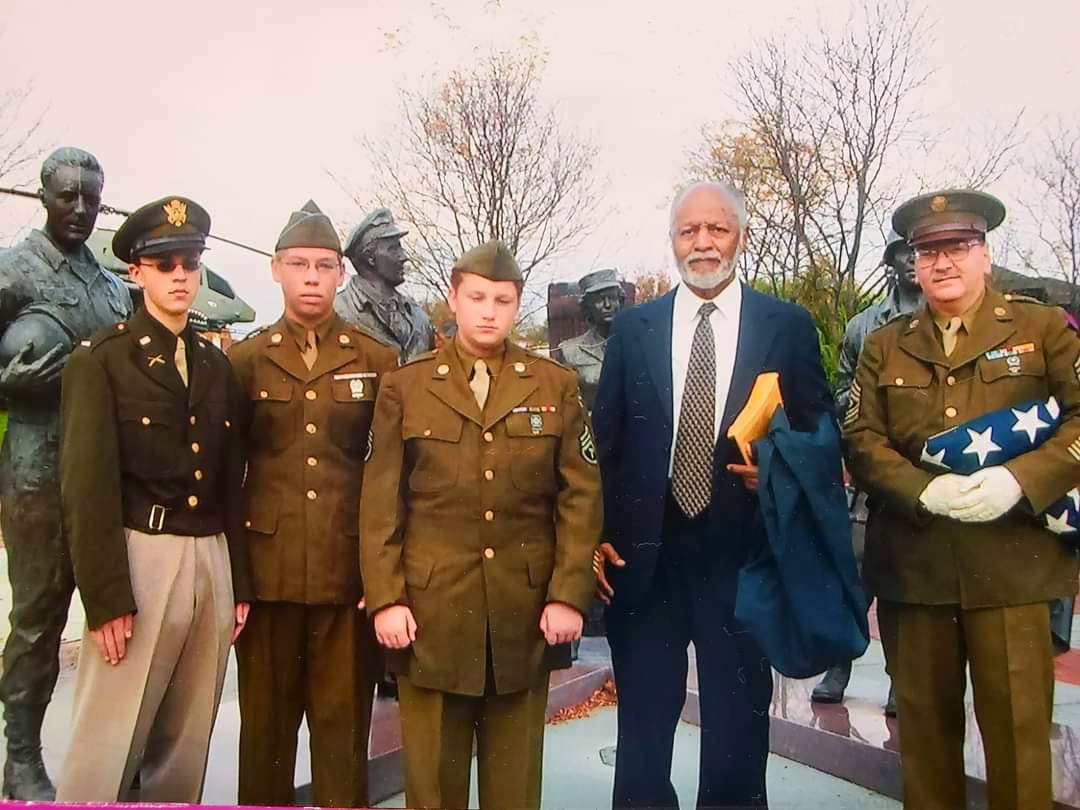
The author on the far right with his three "soldiers" at the Bristol Veteran's Day parade with 1st LT. Dempsey W. Morgan, one of the last of the Tuskegee Airmen.
Rather than just march I'd brought a large 48 star American flag (which was the correct number of stars during the WWII years) and the four of us carried it flat in the parade, one at each corner, much as I've seen large groups carry larger flags at football games on TV. There actually isn't anything in the Army's Drill and Ceremonies Manual that authorizes that sort of carry — I looked — but it looked good and seemed to impress the parade audience. As we proceeded at a slow march, groups of people along the route broke out in applause all along the way, and the guys all stood a little straighter and marched a little tighter each time that happened. There were dozens of current soldiers, sailors, airmen and Marines in uniform all along the route. To a man — and two women — they all came to attention and saluted us as we passed. So did the police officers and Firefighters spaced along the route. So did the Boy Scouts ~ and there were hundreds of them - and the older veterans in their VFW caps and "WWII Veteran" ball caps. So did a group of Vietnam veterans in their biker colors with their "Rolling Thunder" emblems. So did an elderly man in a wheelchair, who with the assistance of a younger man with him, insisted on standing up from his chair to salute as we passed. And so did a 6-year-old boy with a small American flag who was standing with his dad in just about the exact same spot on the sidewalk where I used to stand about 40 years earlier.
And so did a group of older men, veterans all, standing together in the heart of downtown under the marquee of the Paramount Theater where I'd asked them to wait for us. Front and center of that group was Micah's grandfather, wearing his VFW Post Commander's cap and flanked by his VFW buddies and the parents of my three young comrades. As we approached, he caught sight of his grandson who — thanks to a photograph I'd borrowed earlier that week — was wearing the same kind of uniform with the exact same division patch, rank chevrons, and decorations that he'd worn in WWII. It wasn't a proper thing to do since we were carrying the colors, but just as we passed, I called, "Detail, Eyes Right!" just to make sure that Micah and his grandfather crossed that last generation gap together.
A few days later I got a call from Micah's grandfather. He thanked me for putting the boys in the parade and told me that his grandson and he had been talking every day since the parade, not just about his Army days but about his childhood - and Micah's — the post-war years when he was establishing his business and political career, and other family matters. In fact, he was taking Micah and his two fellow marchers from the parade to lunch the next day. It seems the other boys wanted to hear some of the stories too. I guess we all had had a very good Veterans Day.
~~~~~~~~~~~~~
Obituary
Dempsey Wesley Morgan Jr.
Dempsey Wesley Morgan Jr., a distinguished Tuskegee Airman, passed away at the age of 93 on Thursday, April 11, 2013, in Roanoke, Virginia, following an extended illness. A native of Detroit, Michigan, he was born on March 1, 1920, to the late Dempsey Matthew and Pope Morgan.
Summing up the global experiences and profound influence of First Lieutenant Dempsey Morgan in a few words is an impossible task. He is most famously recognized for his stellar service as a combat pilot with the 332nd Fighter Group and the 100th Fighter Squadron of the historic Tuskegee Airmen. During his four years of military service, he received numerous citations for bravery and excellence, including the Certificate of Valor, the Bronze Star, the Air Medal with Four Oak Leaf Clusters, and the Distinguished Flying Cross.
Following his military service, Lieutenant Morgan was granted a commercial pilot's license. However, widespread racial discrimination at the time prevented him from pursuing a career as a commercial airline pilot. Decades later, his historic contributions were formally recognized. In 2006, he received an honorary doctorate in Public Service from Tuskegee University, and in 2007, President George W. Bush awarded the Congressional Gold Medal to the surviving Tuskegee Airmen.
After leaving the military, Lieutenant Morgan embraced the Baha'i Faith. Guided by a deep determination to spread its message of peace, he and his wife, Adrienne, spent the next 40 years traveling and teaching abroad across Asia, Africa, and Central America. The couple eventually returned to the United States due to health reasons, where he continued to teach the principles of his faith until his passing.
Guided by his convictions, he often stated, "I fear no man, only God," adding, "I said the 23rd Psalm every morning and thanked God every evening." He is survived by his wife, three daughters, and several grandchildren.
~~~~~~~~~~~~~
Afterword
Although at some point I had heard of the Tuskegee Airmen, I knew nothing about them. As it turns out the Tuskegee Airmen were the first African American military aviators and support personnel in the United States Armed Forces, serving during World War II.
A little more searching took me to the website for "CAF RISE ABOVE - Inspiring young people to RISE ABOVE adversity using
the lessons and stories of the Tuskegee Airmen and the WASP."
The photo below is from the webpage entry for Tuskegee Airmen Dempsey W. Morgan. If you click on the photo you will go that tribute page.
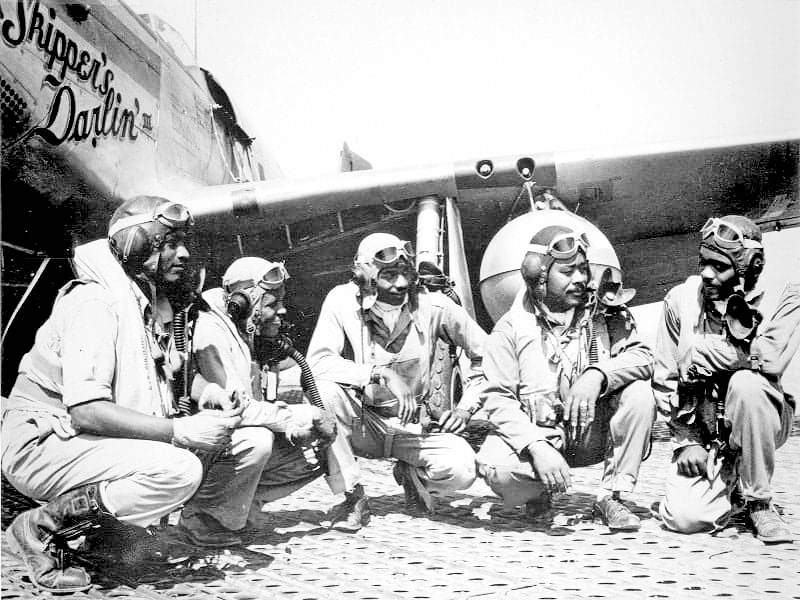
332nd Fighter Pilots Left to Right: Dempsey W. Morgan, Carroll S. Woods, Robert H. Nelson, Andrew D. Turner, Clarence P. Lester
Copyright © 2026 - CAF RISE ABOVE®
I would like to express my gratitude to author Curt Phillips and my brother, William Mark Breiding, for their assistance with this page.
There is a PDF of The Essayist here.